

Does PTO count toward overtime? Generally, no: under the federal Fair Labor Standards Act (FLSA) calculation, vacation, sick leave, and a paid holiday off are not hours worked merely because they are paid. For a covered, nonexempt employee, the usual federal overtime threshold is more than 40 hours actually worked in the employer’s fixed workweek. The practical first step is to separate hours worked from hours paid.
Does PTO count toward overtime under federal law?
The FLSA generally requires covered, nonexempt employees to receive at least one-and-one-half times their regular rate for hours worked over 40 in a workweek. A workweek is a fixed, recurring period of seven consecutive 24-hour days. It may start on any day and at any hour, but the employer generally cannot average a long week against a short week in the next pay period.
Paid time off is compensation for an absence, not time spent performing work. The Department of Labor’s FLSA Hours Worked Advisor says paid holiday, vacation, and sick time that is not worked is not included in the federal overtime total. The same distinction appears in the rules for pay for occasional periods when no work is performed, including vacation, holidays, and illness.
This is a federal baseline, not a promise that every employer’s policy stops there. A state law, collective bargaining agreement, employment contract, or company policy may credit paid leave toward a more generous overtime benefit. Check the rule that applies to the job before treating the federal calculation as the only possible result.
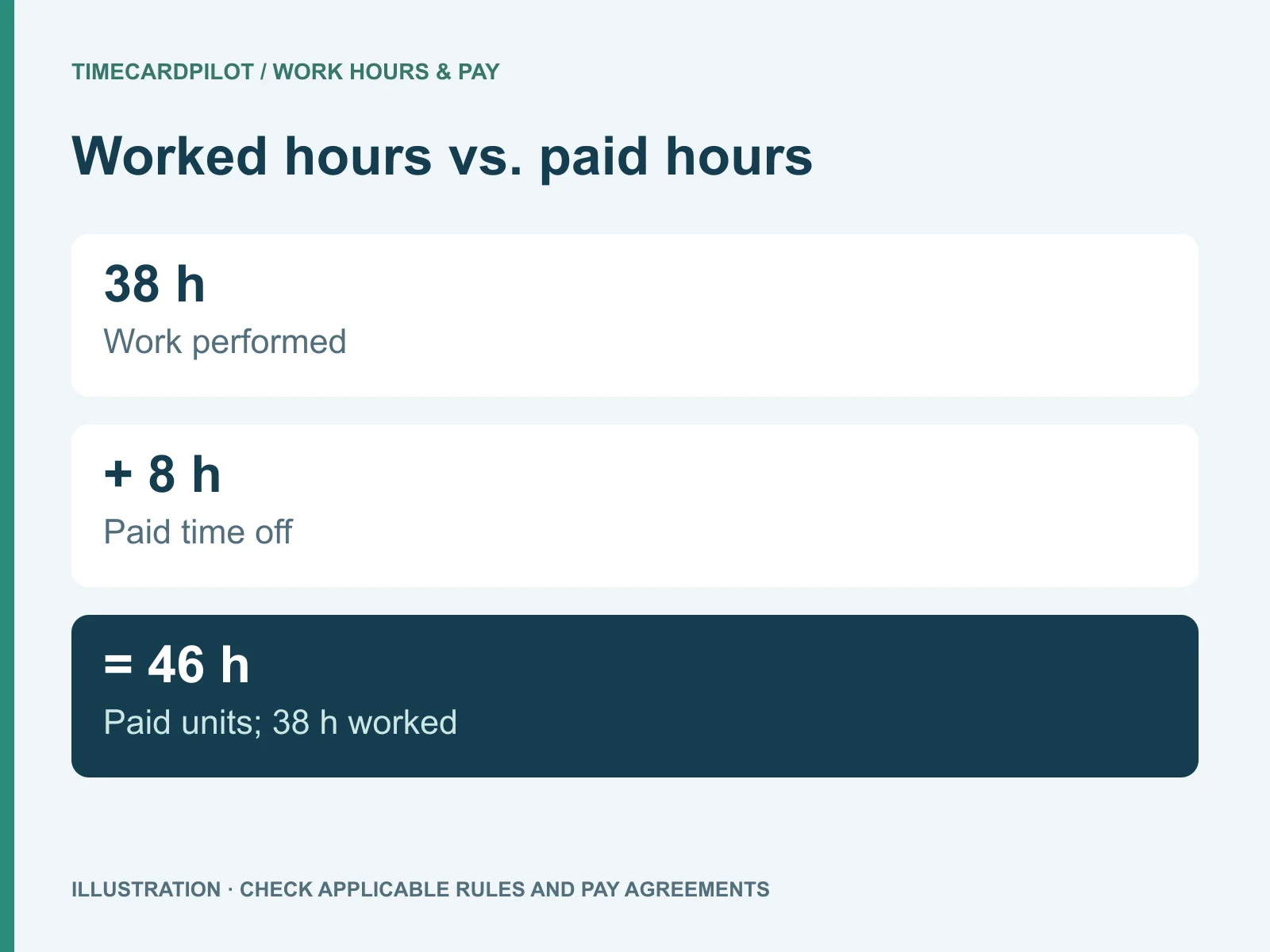
Worked hours and paid hours can differ
A timesheet may show work time, while a pay statement may also include PTO, holiday pay, or other earnings. Those figures can differ without being a payroll error. For the general federal overtime test, use work actually performed during the fixed workweek; do not add leave hours just because they appear in the paid-hours total.
| Example week | Hours worked | Paid leave | Total paid hours | Federal overtime hours |
|---|---|---|---|---|
| 38 work hours plus 8 PTO | 38 | 8 | 46 | 0 |
| 40 work hours plus 8 PTO | 40 | 8 | 48 | 0 |
| 42 work hours plus 8 PTO | 42 | 8 | 50 | 2 |
The last column uses only the general federal weekly threshold for a covered, nonexempt employee. It does not decide whether a state daily-overtime rule, another occupation-specific rule, or a more generous leave policy applies. It also does not calculate the overtime dollars due; the regular rate can include compensation beyond a simple hourly base rate.
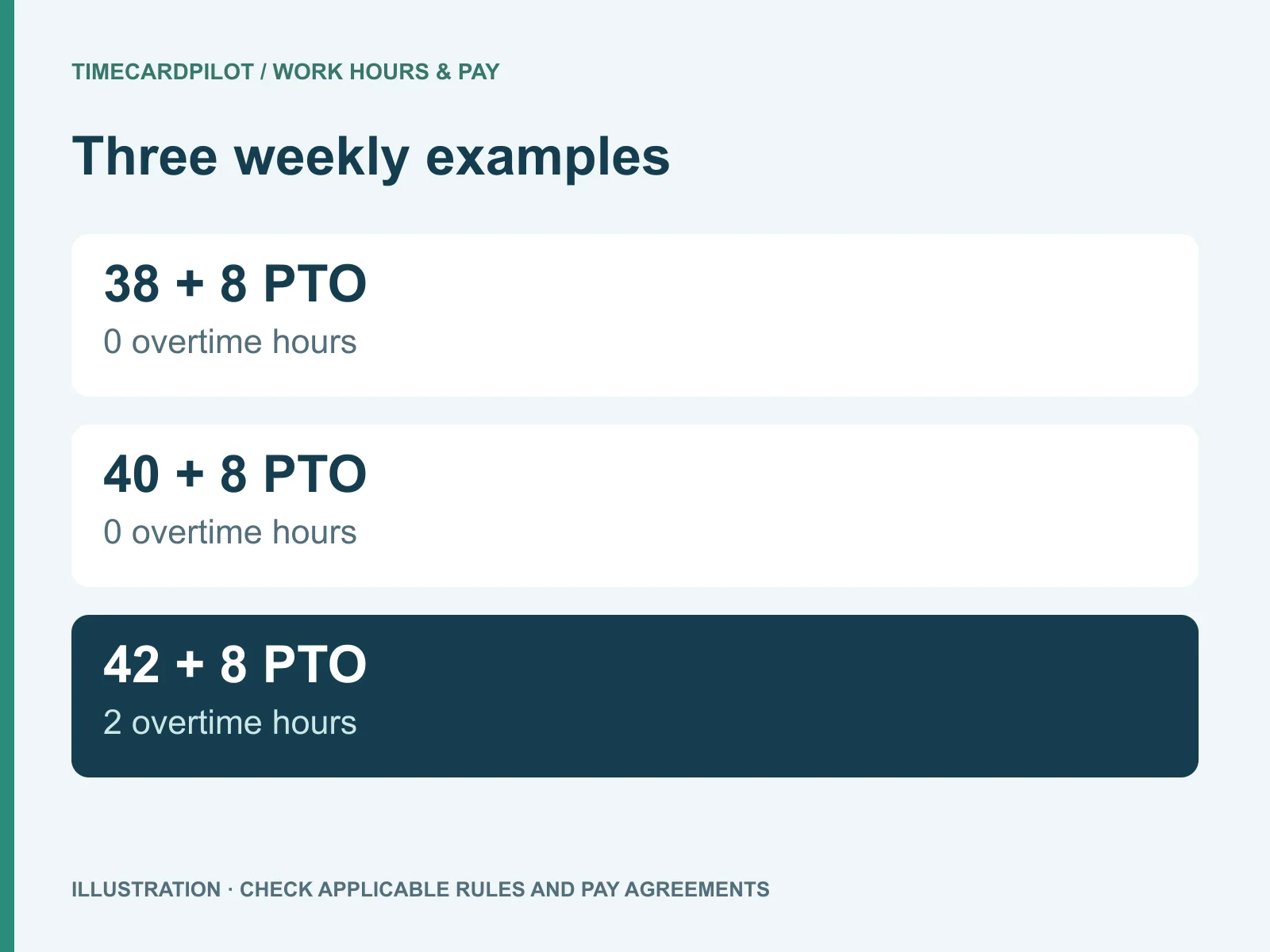
How PTO affects an overtime calculation
- Find the employer’s workweek. Use its recurring seven-day boundary, not automatically the Sunday-to-Saturday calendar or the full pay-period dates.
- List the hours actually worked. Include compensable work before or after a scheduled shift and work performed during an interrupted meal period. Do not remove work just because it was unscheduled.
- Separate PTO from work time. Record vacation, sick leave, and holiday hours in the appropriate paid-leave category. Do not convert a leave balance or a paid absence into hours actually worked.
- Apply the relevant overtime rule. Compare the work-hour total with the federal threshold and check any applicable state, local, agreement, or policy rule.
- Compare the result with payroll. Review the workweek dates, leave code, regular rate, and overtime line on the pay statement. If the calculation is unclear, ask payroll which hours were treated as worked and which leave policy was applied.
If the question is whether a specific holiday premium is required, see TimeCardPilot’s separate holiday pay vs. overtime guide. For the general federal and state threshold distinction, review the overtime-after-8-or-40-hours explanation. The overtime calculator can help organize weekly hours, but it cannot determine legal coverage or which state rule governs.
When an employer may count PTO anyway
An employer can choose to provide a benefit that is more generous than the FLSA minimum. For example, a written policy may credit paid holidays or PTO toward an internal weekly premium even when the federal hours-worked threshold has not been crossed. That is a policy benefit, so read the applicable plan or agreement and ask how it is calculated. Do not confuse “the employer counts PTO for this benefit” with “federal law treats PTO as time worked.”
Some payroll arrangements also pay a fixed salary or other compensation that covers a defined schedule. In those cases, the pay amount and the overtime calculation may not map one-to-one to the timesheet’s “paid hours” label. The employee’s classification, the pay agreement, the regular rate, and the applicable law all matter. A displayed total of 48 paid hours alone does not show whether overtime is owed.
Common PTO and overtime mistakes
- Counting leave as worked time automatically. Keep work and leave in separate categories, then apply the particular policy.
- Using the pay period as the overtime period. Federal overtime is tested by workweek; two-week totals should be split into the employer’s two fixed workweeks.
- Assuming holiday work is the same as a holiday off. Time actually worked on a holiday is work time; paid holiday hours for a day not worked are different.
- Subtracting an interruption from a meal break. If work occurred, record the actual work and raise a timecard correction instead of relying on the planned break code.
- Assuming every state uses the federal rule. State or local rules and employer agreements may provide a different or more generous result.
The Department of Labor’s recordkeeping guidance says covered employers must keep accurate records of hours worked each day and each workweek. Its Fact Sheet #21 also explains that federal rules do not require one particular timekeeping form. A paper timesheet, employer app, or time clock can be used if the record is complete and accurate.
Frequently asked questions
Does PTO count toward 40 hours for federal overtime?
Generally, paid vacation, sick leave, and a paid holiday off are not hours worked under the FLSA. A state rule, agreement, or employer policy may provide a more generous credit.
If I receive 48 paid hours, does that mean I worked overtime?
No. The total may include leave or holiday pay. Check actual hours worked in each fixed workweek and then review any policy that separately credits paid leave.
Does working on a holiday count as hours worked?
Work actually performed on a holiday is hours worked. Federal law does not require a special holiday overtime premium by itself, but overtime may be due when the applicable threshold is reached.
Can my employer count PTO toward an extra company overtime benefit?
A policy or agreement may provide a benefit beyond the federal minimum. Read the plan’s terms and ask payroll how leave is credited; that does not change the general federal definition of hours worked.
What should I do if my timecard and pay statement disagree?
Compare the workweek dates, actual punches, leave entries, and overtime calculation. Submit a correction through the employer’s process and keep a copy of the records and response.
Last updated: November 23, 2026. Federal information only; state and local rules, agreements, and employer policies may differ.