

Salaried nonexempt employees can qualify for overtime because “salary” describes how a worker is paid, while “nonexempt” describes whether overtime protections apply. Under the general federal Fair Labor Standards Act (FLSA) rule, most covered, nonexempt employees must receive at least time-and-one-half their regular rate for hours worked over 40 in a fixed workweek. A job title, annual salary, or offer letter that says “manager” does not by itself establish an exemption.
When does a salaried nonexempt employee earn overtime?
A salaried employee can be nonexempt and overtime-eligible. If the FLSA covers the job and no exemption applies, the employee must be paid for all hours worked and receive overtime under the applicable calculation method. The employer may use a salary instead of an hourly wage, but it still needs an accurate way to determine hours worked and the regular rate.
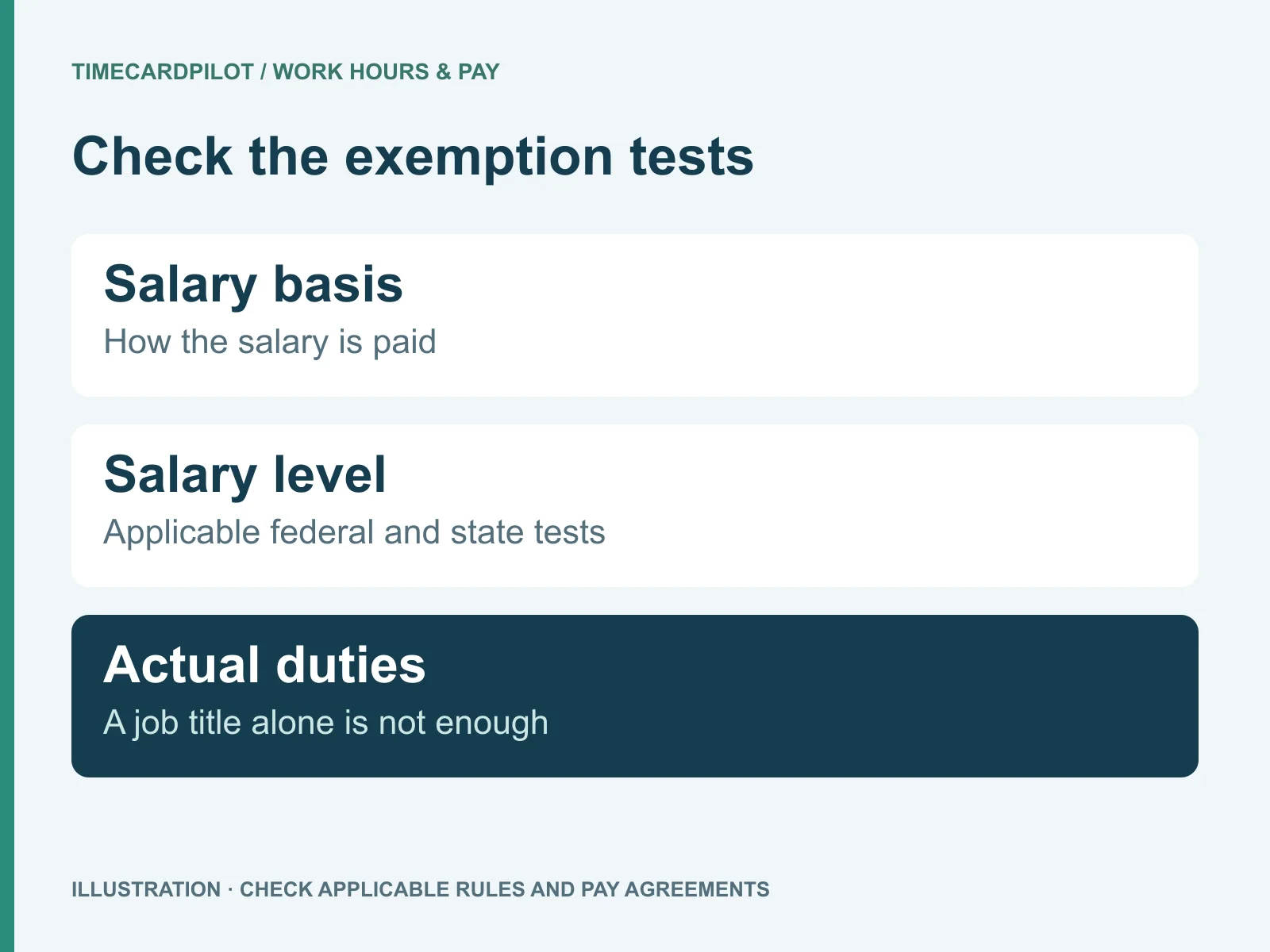
The key question is not simply “hourly or salary?” It is whether the employee meets every requirement of a particular overtime exemption. For the common executive, administrative, and professional exemptions, federal rules generally look at the salary basis, the salary level, and the employee’s actual primary duties. The U.S. Department of Labor says job titles do not determine exempt status; the specific duties and pay must meet the rules.
Exempt vs nonexempt: how the federal tests fit together
- Coverage and occupation. Confirm whether the FLSA and the specific exemption apply to the employer and job. Some occupations have separate rules or different exemption tests.
- Salary basis. For the common executive, administrative, and professional exemptions, the worker generally must receive a predetermined salary that is not reduced because of variations in the quality or quantity of work, subject to defined exceptions.
- Salary level. As of November 23, 2026, the DOL’s current salary-level page lists a standard federal threshold of $684 per week for most executive, administrative, and professional exemptions. The page lists a $107,432 total annual compensation requirement for certain highly compensated employees, including at least $684 per week paid on a salary or fee basis. Other occupations and territories may use different tests.
- Duties. The actual primary duties must satisfy the executive, administrative, professional, or other applicable test. Having a “supervisor,” “analyst,” or “administrator” title is not enough.
The DOL restored the applicable 2019 exemption regulations through a technical amendment in May 2026 after a court vacated the 2024 salary-level rule. Check the DOL’s current salary-level page when reviewing a classification because thresholds and rules can change. State or local law may require a higher salary or impose additional duties criteria; the federal amount is not a nationwide safe harbor.
What changes when a salaried employee is nonexempt?
A nonexempt salaried employee still needs an accurate work-hour record. The employer should count compensable work, including work it knows about or allows outside the posted schedule, and determine overtime for each fixed workweek rather than averaging a two-week pay period. A salary does not authorize off-the-clock work or waive the overtime premium.
How the premium is calculated depends on what the salary was intended to cover and what arrangement is valid under the FLSA and applicable state law. Do not assume that every salaried nonexempt employee has the same regular-rate calculation.
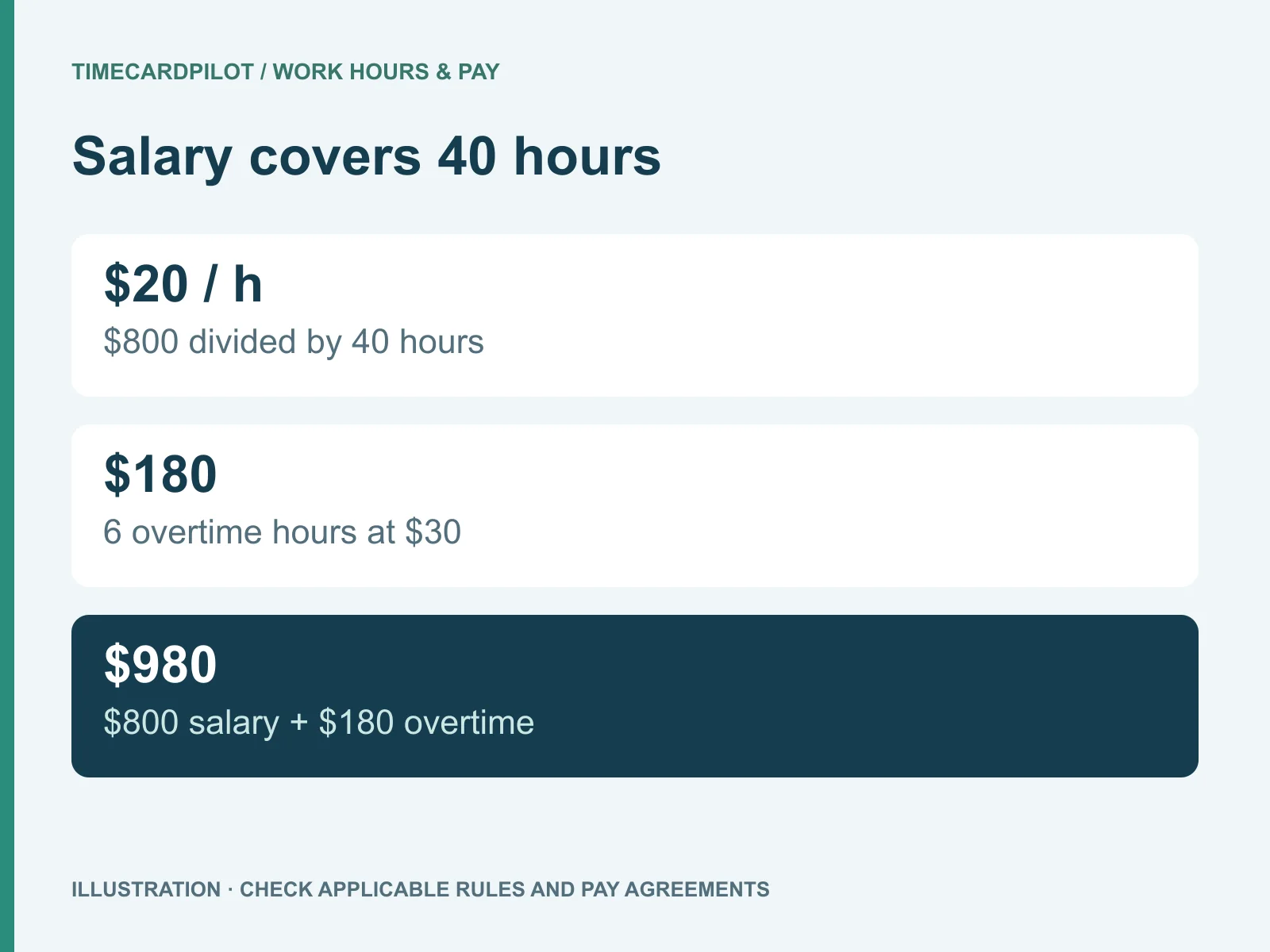
Example: salary covers a 40-hour workweek
Suppose a covered nonexempt employee receives $800 for a 40-hour workweek and works 46 hours. Under this stated example, the salary covers straight-time pay for the first 40 hours. The regular rate is $800 ÷ 40 = $20 per hour. The employee has 6 overtime hours, so the additional overtime pay is 6 × $30, or $180. Total gross pay for the week is $980 before other compensation or deductions.
This is a simplified illustration with no bonus, shift differential, second rate, or state daily overtime. A nondiscretionary bonus or other included compensation can change the regular rate. TimeCardPilot’s regular-rate guide explains why the overtime rate may be different from the employee’s posted base rate.
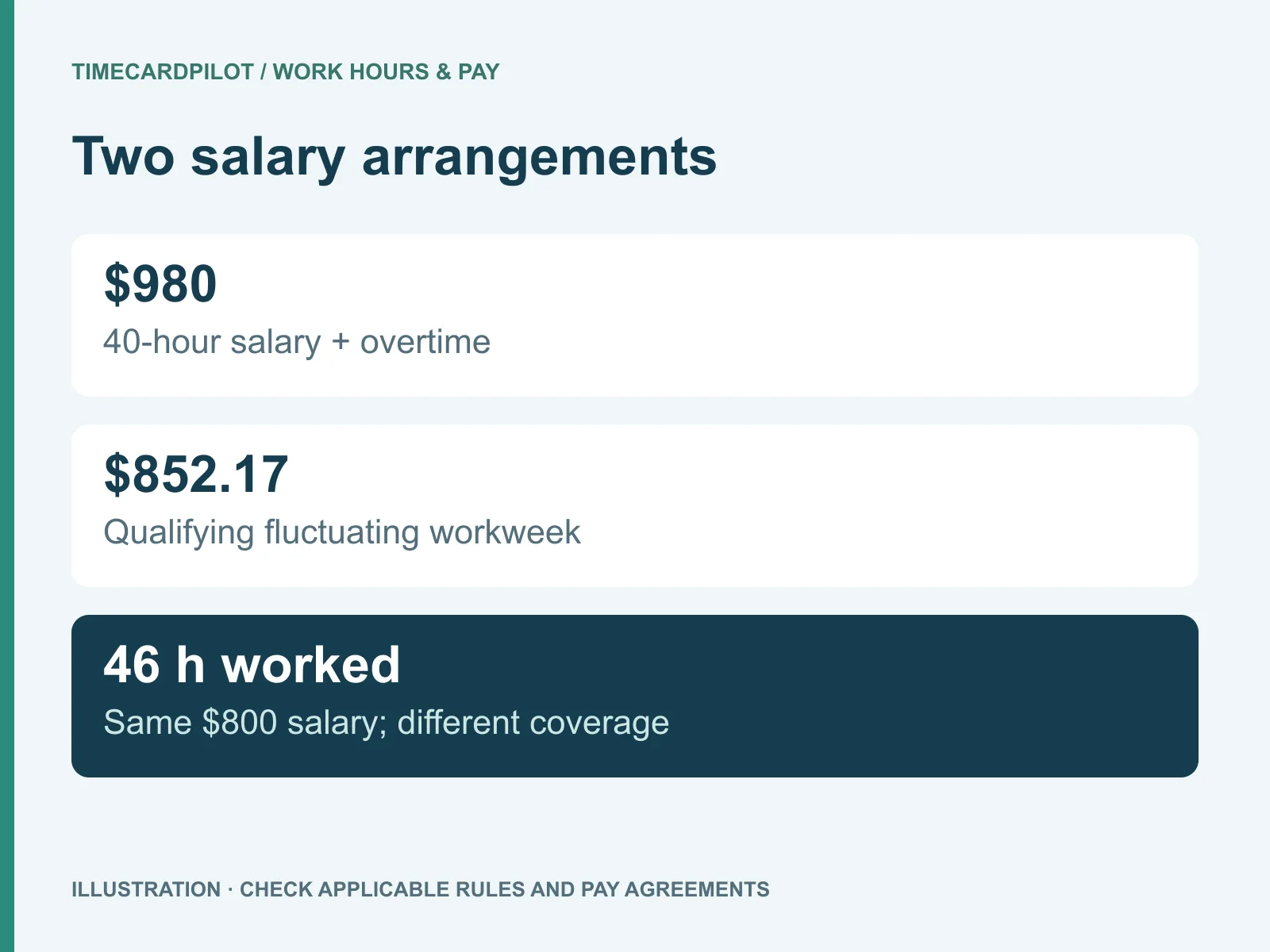
When a salary may cover all hours in a fluctuating workweek
Federal rules also describe a fluctuating-workweek method for certain nonexempt employees whose hours vary from week to week. It is not an automatic result of being paid a salary. The salary must be fixed and satisfy the rule’s conditions, including a clear understanding that it compensates all hours worked in the workweek, whether few or many; overtime is then paid as an additional half-time premium for hours over 40. State law may restrict or disallow this method.
For illustration only, if a qualifying arrangement provides a fixed $800 salary for all hours and the employee works 46 hours, the regular rate for that week is $800 ÷ 46, or about $17.39. The additional half-time premium on 6 overtime hours is ($800 ÷ 46) × 0.5 × 6 = $52.17, rounding only the final amount. The result is not the same as a salary that covers only 40 hours. Whether this method is valid depends on the agreement, facts, and applicable law; do not use this example as a payroll formula without review.
How to check whether you are salaried and nonexempt
- Ask payroll or HR for the written classification: exempt or nonexempt, and which exemption is being applied if the job is treated as exempt.
- Compare the actual primary duties with the DOL’s relevant duties test. Do not rely only on the job title or the fact that the employee supervises occasional tasks.
- Check the salary basis and federal salary level that apply to the specific exemption, then check whether state or local law sets a different standard.
- If nonexempt, record all work time and confirm the employer’s fixed workweek start and end. A biweekly pay period is not necessarily the overtime calculation period.
- Review each pay statement for the workweek, hours, regular rate, overtime hours, and any compensation that may affect the regular rate.
For a general threshold overview, read is overtime after 8 hours or 40 hours? You can use the overtime calculator to organize hours, but a calculator cannot decide whether a legal exemption applies or what salary method your employer uses.
Common classification mistakes
- “I get a salary, so I am exempt.” Salary pay alone is not the exemption test.
- “My title says manager.” Actual duties and all other exemption requirements matter.
- “I am under $684 a week, so no other facts matter.” The salary level is only one part of the common EAP test, and other categories have different rules. State law may be more protective.
- “A salary means overtime is included automatically.” The agreement must satisfy the applicable method; overtime obligations cannot be waived by a label.
- “Payroll can average two weeks.” The general FLSA overtime calculation is week by week. Hours over 40 in one week are not canceled by fewer hours in another.
Frequently asked questions
Can a salaried employee be nonexempt?
Yes. Salary is a pay method, and nonexempt status means overtime protections still apply. A covered nonexempt employee generally must be paid overtime for hours over 40 in each workweek.
What is the federal salary threshold for the common EAP exemptions in 2026?
The DOL’s current salary-level page lists $684 per week for most executive, administrative, and professional exemptions. The employee must also satisfy the applicable salary-basis and duties tests, and state law may require more.
Does a job title decide whether overtime is due?
No. The DOL says the actual duties and pay must meet the requirements of a specific exemption. A title such as manager or analyst alone does not decide the result.
How is overtime calculated for a salaried nonexempt worker?
It depends on what the salary covers and the valid pay arrangement. A salary for 40 hours differs from a qualifying fluctuating-workweek arrangement; bonuses, multiple rates, and state law can also affect the calculation.
Should a salaried nonexempt employee track hours?
Yes. Accurate daily and weekly hours help calculate overtime and reconcile a pay statement. The employer may choose the timekeeping method, but the record must be complete and accurate.
Last updated: November 23, 2026. Federal information only; state and local rules may differ.