

Payroll for overnight shifts during daylight saving time changes can be confusing because the wall clock may repeat or skip a local hour. The timecard should preserve the actual start and end of work across the clock change, then separate elapsed time from unpaid breaks and paid leave. The U.S. Department of Labor’s general federal overtime rule is based on hours worked in a fixed workweek; a shift’s displayed clock length alone does not determine overtime.
Overnight shift payroll examples for daylight saving time in 2026
In most places that observe daylight saving time, clocks move ahead from 2 a.m. to 3 a.m. on the second Sunday in March and move back from 2 a.m. to 1 a.m. on the first Sunday in November. The National Institute of Standards and Technology lists the 2026 transitions as March 8 and November 1. Hawaii, most of Arizona, and several U.S. territories do not observe daylight saving time, so confirm the local rule where the shift occurs.
When clocks move back, the local 1 a.m. hour happens twice. When clocks move ahead, the local 2 a.m. hour is skipped. A time record that stores only a label such as “1:30 a.m.” can be ambiguous on the fall transition unless it also identifies which occurrence, time zone, or UTC offset applies.
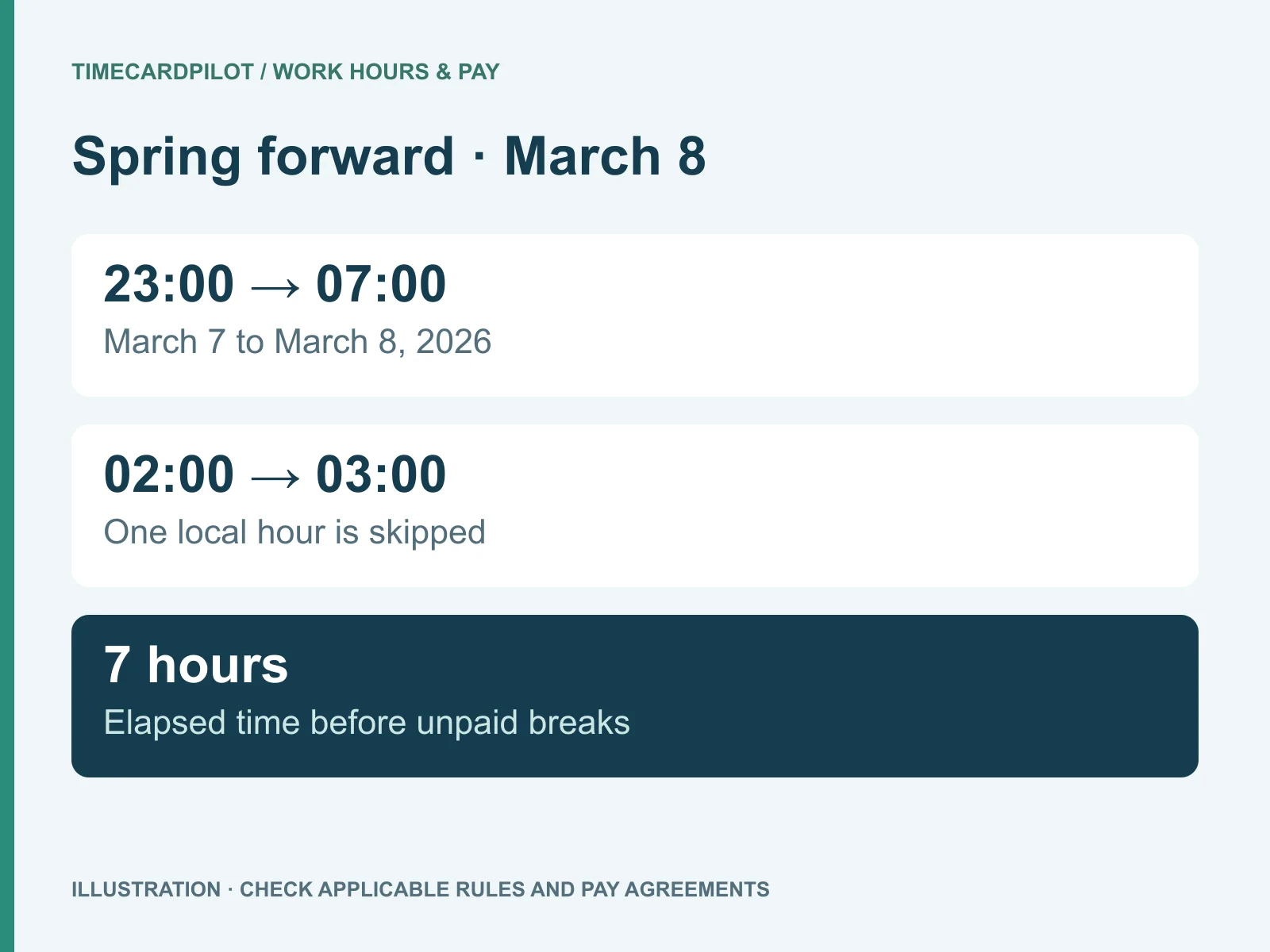
Calculate the actual elapsed hours across the clock change
For an overnight shift, record the date on both punches and calculate elapsed time on a real timeline. Then subtract only a meal period that qualifies as unpaid under the applicable rules. These hypothetical examples assume the employee is working in a location that observes the 2026 change and remains in the same time zone.
| Transition | Example shift | Clock change | Elapsed span before breaks |
|---|---|---|---|
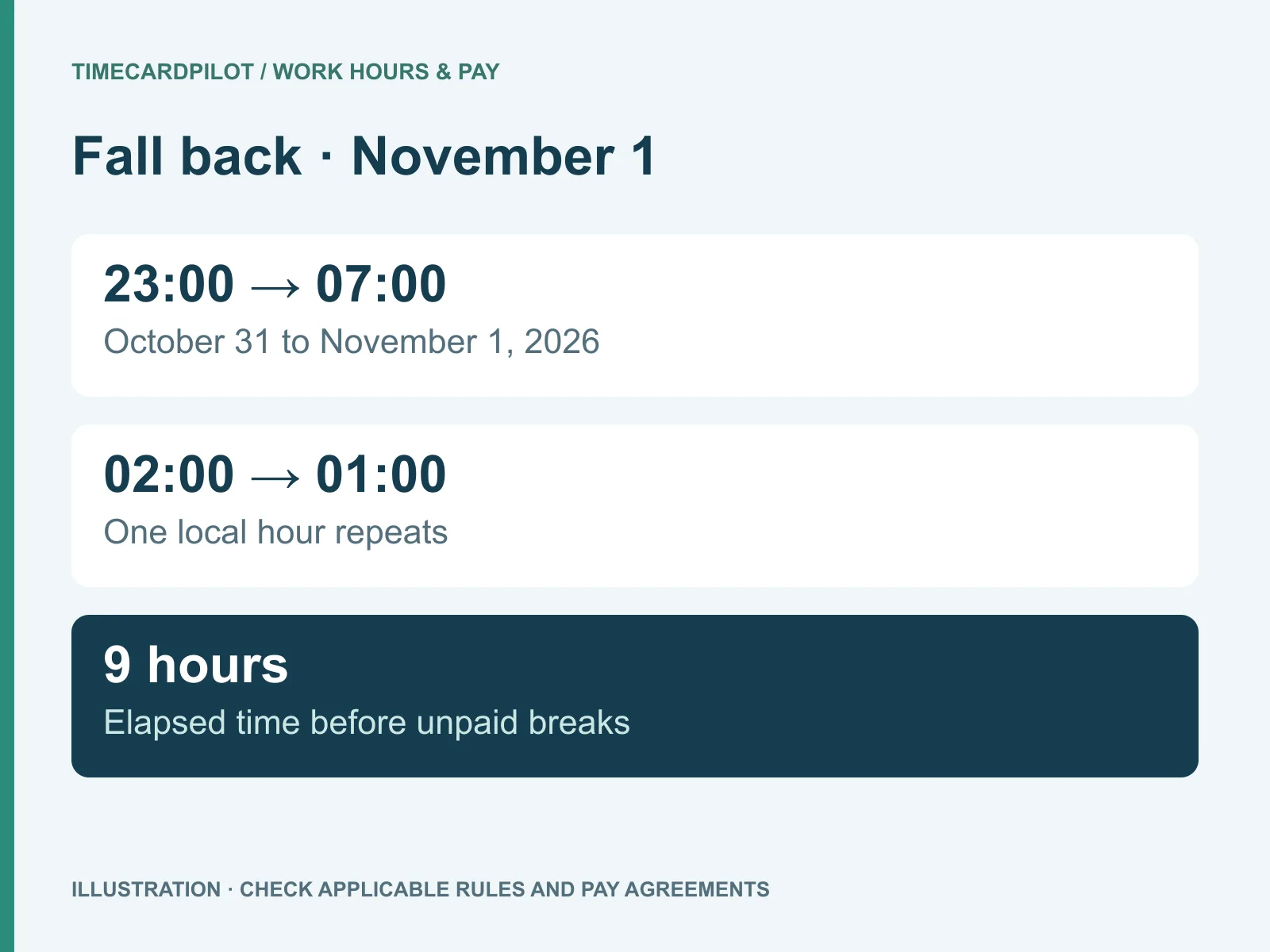
| Fall back, Nov. 1, 2026 | Saturday Oct. 31 at 11 p.m. to Sunday Nov. 1 at 7 a.m. | At 2 a.m. daylight time, clocks return to 1 a.m. standard time; the 1 a.m. hour repeats. | 9 hours |
| Spring forward, Mar. 8, 2026 | Saturday Mar. 7 at 11 p.m. to Sunday Mar. 8 at 7 a.m. | At 2 a.m. standard time, clocks advance to 3 a.m. daylight time; the 2 a.m. hour is skipped. | 7 hours |
The examples compare elapsed time, not guaranteed pay. If the fall shift includes a 30-minute meal that is properly unpaid, the work time is 8.5 hours. If the spring shift includes the same qualifying unpaid meal, the work time is 6.5 hours. Whether an employer pays a scheduled shift length instead of the elapsed hours can depend on the pay agreement, employer policy, and state law; the time record should still show what actually happened.
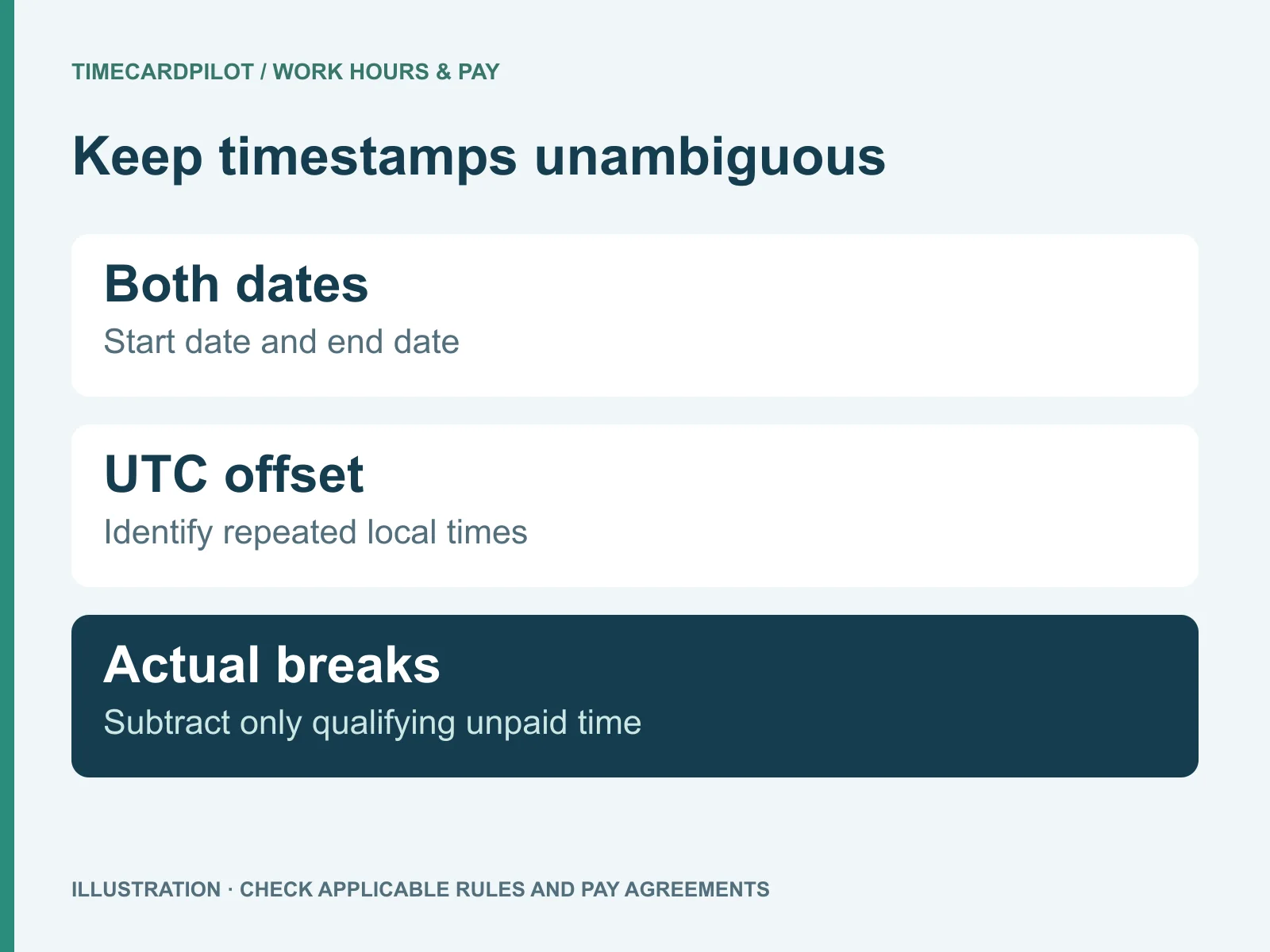
What to enter on a timecard
- Keep both dates. Record the shift start date and the next-day end date, including when the shift crosses midnight.
- Identify the time zone or offset. On the fall transition, record enough information to distinguish the first 1:30 a.m. from the repeated 1:30 a.m. A system that stores an unambiguous timestamp or UTC offset can help.
- Record the actual punches. Do not manually change 1:30 to 2:30 just to make the times appear sequential. Add a note or use the system’s daylight-saving field if it has one.
- Enter breaks separately. Record the actual beginning and end of meal periods and note interruptions. Do not subtract a scheduled break that was not taken or during which work continued.
- Compare with payroll’s workweek. The employer’s fixed workweek boundary determines which workweek receives the hours. A shift that crosses midnight or the workweek boundary may need its time split according to the recordkeeping method.
TimeCardPilot’s overnight-shift calculator guide explains how to handle a shift that crosses midnight on an ordinary day. The hours-between-times calculator uses local clock arithmetic and does not infer daylight saving changes or UTC offsets. Do not use its unadjusted result for a clock-change shift. For that shift, use payroll timestamps with explicit offsets, or convert both punches to UTC before subtracting them. The timecard instructions cover corrections and missing punches.
How the clock change affects overtime
Under the general FLSA rule, covered, nonexempt employees receive overtime for hours worked over 40 in a fixed workweek. Federal law generally does not require daily overtime merely because a shift is longer than eight hours. Some state laws add daily or other overtime requirements, and an employment agreement or employer policy may provide additional pay.
Use the unambiguous actual work hours to calculate the weekly total, and then apply the rule for the employee’s work location and classification. The fall example above adds one more elapsed hour than the same wall-clock shift on an ordinary night; the spring example adds one fewer. Neither example by itself decides whether overtime is due. Compare the entire workweek and check state-specific rules, including any applicable workday definition.
If a pay statement appears to omit the repeated hour, preserve the timecard, schedule, location, and time-zone details. Ask payroll which punches and workweek boundary were used. If a record contains duplicate local times, request the underlying timestamps or the employer’s documented daylight-saving conversion rather than changing the original punch yourself.
Common clock-change payroll mistakes
- Subtracting one hour automatically in spring. First confirm actual start and end timestamps and breaks; the schedule or pay agreement may provide a different paid amount.
- Missing the repeated fall hour. A clock label can appear twice, so preserve the date, time zone, or offset for each punch.
- Using only the scheduled duration. A schedule is useful context, but compare it with actual work and qualifying breaks.
- Using a calendar week instead of the employer’s workweek. Apply the fixed weekly boundary when totaling federal overtime hours.
- Assuming every U.S. location changes clocks. Verify local observance; several U.S. regions do not observe daylight saving time.
Frequently asked questions
How many hours are worked on a fall-back overnight shift?
It depends on the exact start and end instants. In a location observing daylight saving time, a shift from 11 p.m. before the 2026 fall change to 7 a.m. after it spans nine elapsed hours before unpaid breaks.
How many hours are worked when clocks spring forward?
A shift from 11 p.m. before the 2026 spring change to 7 a.m. after it spans seven elapsed hours before unpaid breaks in a location that observes the change. Record the actual dates and time zone.
Does a repeated hour automatically create overtime?
No. The federal overtime test generally uses total hours worked in the fixed workweek, while state law may add a daily test. A longer shift alone does not answer the full calculation.
Should the timecard show the same 1:30 a.m. punch twice?
If both punches occurred at 1:30 a.m. during the fall transition, preserve both actual entries and identify the time zone or offset so the repeated hour is clear. Do not alter a punch to force the clock labels into order.
Does payroll have to pay the scheduled shift length in spring?
The federal hours-worked rule focuses on compensable work actually performed; an employer may also have a more generous schedule policy or agreement. Check the applicable state rule and written pay arrangement.
Last updated: November 23, 2026. Federal information only; state and local rules and employer agreements may differ.