

What is the difference between hours worked and hours paid on your pay stub? In payroll terms, hours worked measure compensable time an employee actually performs work; hours paid may also include paid leave, a holiday, or another pay category. The labels are related but not interchangeable. A weekly timecard and a pay statement can therefore show different totals without either one being wrong.
The difference between hours worked and hours paid
Hours worked are time that counts as work under the applicable wage-and-hour rules. Under the federal Fair Labor Standards Act (FLSA), work can include required tasks performed before or after a scheduled shift, short rest breaks, and certain waiting time. A meal period is generally not work time only when the employee is completely relieved from duty. State law may set additional requirements.
Hours paid is a label many employers use for the time or paid units shown on a pay statement. It may combine hours worked with vacation, sick leave, paid holidays, or other paid absences. The FLSA does not generally require private employers to provide paid vacation or holiday time, but an employer policy, contract, or another law may provide it.
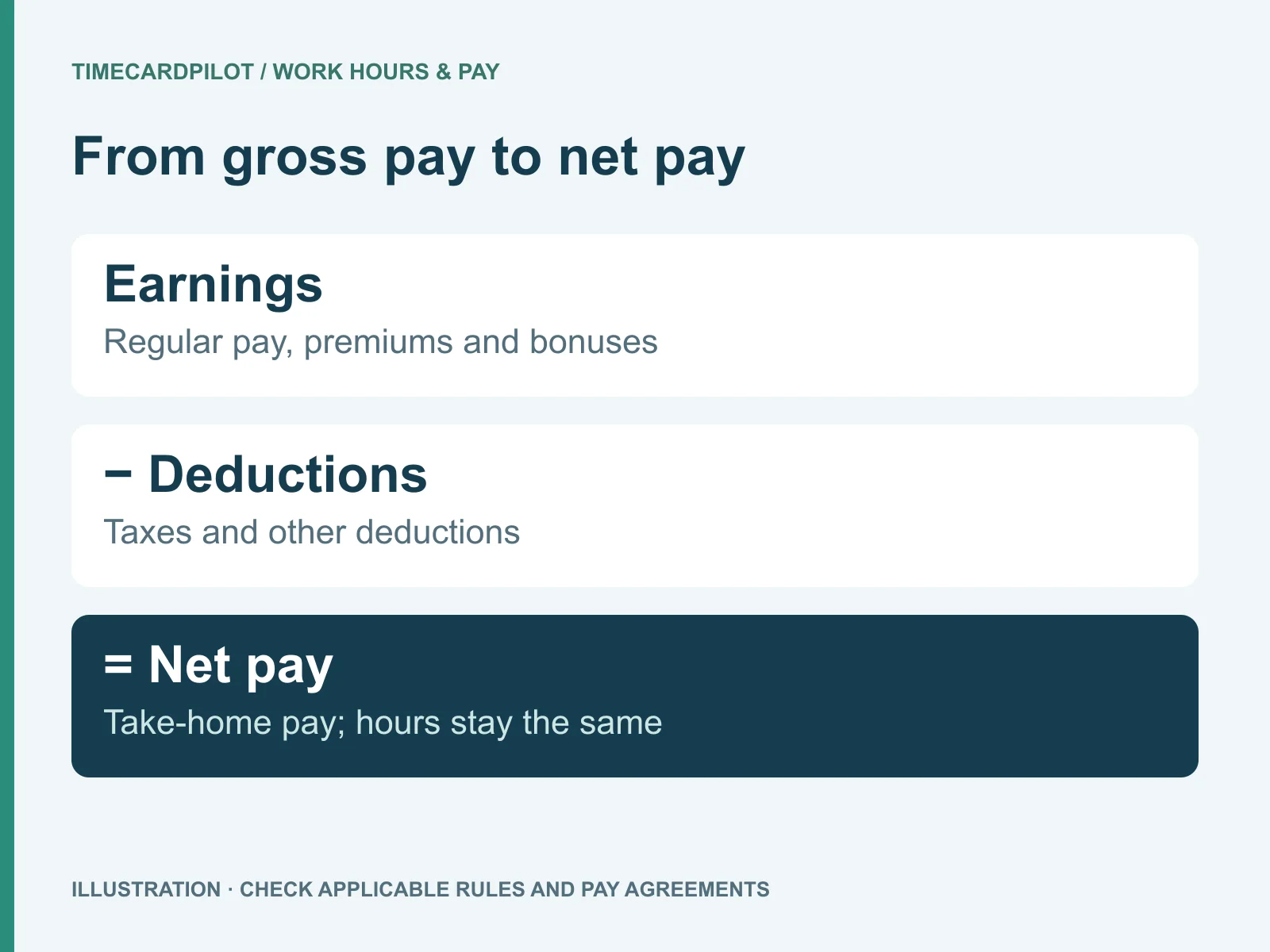
Gross wages and take-home pay are money amounts, not hour totals. Overtime premiums, shift differentials, bonuses, and corrections from a prior period can change gross wages even when the work-hour total is unchanged. Taxes and other deductions reduce gross wages to take-home pay; they do not reduce gross wages or hours worked. A pay-period cutoff can also make a timecard and paycheck cover different dates.
How the difference appears on a timecard and pay stub
| Example week | Hours worked | Other paid time | Hours paid shown | Federal overtime hours under the general rule |
|---|---|---|---|---|
| Regular work plus PTO | 38 | 8 hours of PTO | 46 | 0 |
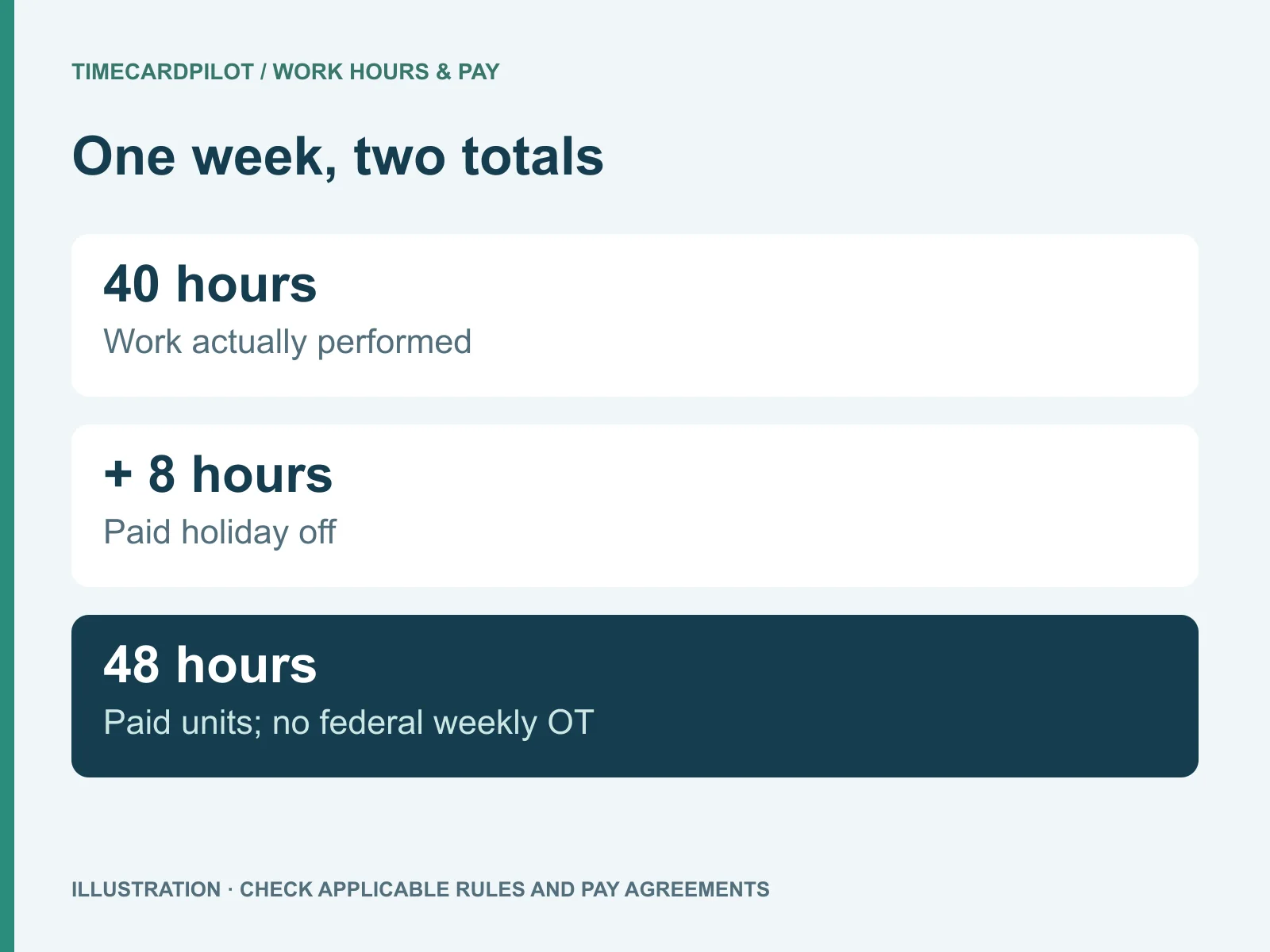
| Work plus a paid holiday off | 40 | 8 holiday hours | 48 | 0 |
| Workweek above 40 plus PTO | 42 | 8 hours of PTO | 50 | 2 |
The overtime column is a general federal example for a covered, nonexempt employee. It counts hours actually worked in the employer’s fixed workweek, not all paid units. A state or local rule, collective bargaining agreement, or employer policy may count additional categories for a more generous benefit. Read the policy before deciding that a difference is an error.
For the PTO-specific question, see when PTO counts toward overtime. The separate holiday pay vs. overtime explanation distinguishes a holiday worked from a paid holiday off.
Breaks can change the hours-worked total
Suppose a shift runs from 9 a.m. to 5 p.m. The elapsed span is eight hours. If the employee takes a 30-minute meal period and is completely relieved from duty, the federal work-hours total for that shift is generally 7.5 hours. If the worker must answer customer messages or perform assigned tasks during the meal, the entry may need correction; the record should reflect what actually happened.
Short rest breaks are usually counted as work time under federal guidance. The FLSA does not require a particular punch format, so employers may use a clock, app, or written form if the record is complete and accurate. Some state and local laws require specific meal or rest breaks, so the federal description is not a complete rule for every location.
TimeCardPilot’s timecard entry guide covers recording in and out times, missed punches, and break codes. Keep the original entries available when submitting a correction.
Why your timecard and pay stub may differ
- Different date ranges. A timecard may display the employer’s workweek, while a pay statement covers the payroll period or includes a prior correction. Compare the exact start and end dates.
- Paid leave is shown separately. PTO, sick time, and holiday pay can increase paid hours without increasing federal hours worked for overtime.
- Work and paid breaks are coded differently. A paid short rest break generally remains work time; a qualifying unpaid meal may be excluded. Check whether the timecard matches the break actually taken.
- Overtime is a pay category. The timecard may show the total hours, while the pay statement separates regular and overtime hours or shows an overtime premium as an additional amount.
- The regular rate changed. Nondiscretionary bonuses, shift differentials, or multiple pay rates can affect overtime pay without changing the number of hours worked. See the regular-rate guide.
- A correction was applied later. A missed punch or rate adjustment may be paid on a later statement. Keep the correction confirmation and identify which workweek it changes.
How to reconcile the two records
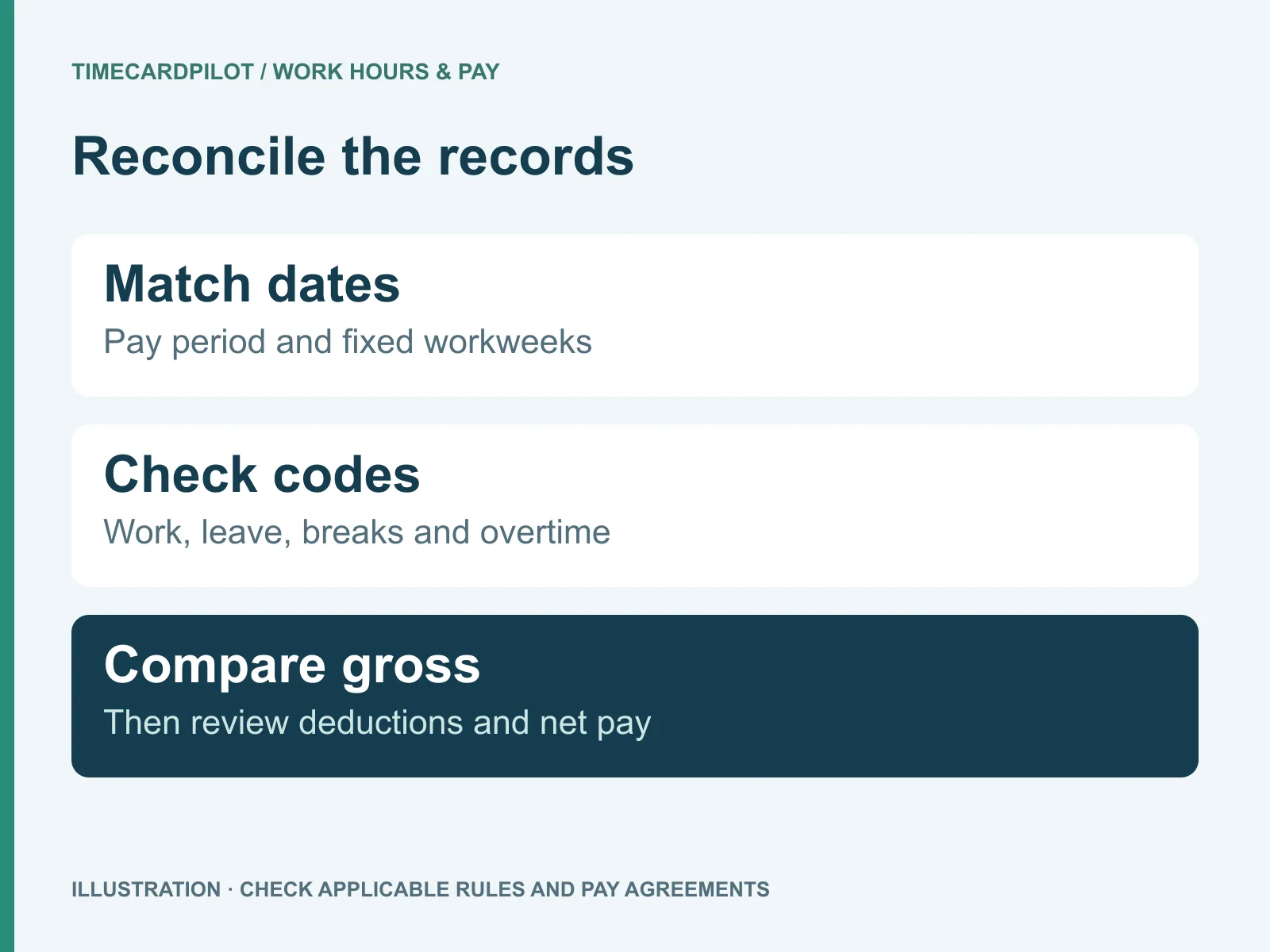
- Match the dates first. Identify the exact pay period on the statement and the fixed workweek dates used for overtime. A biweekly check can include two separate workweek calculations.
- Total work by day. Compare start, stop, and break entries. Include work performed before or after the schedule and correct missing punches through the employer’s process.
- Separate leave and holiday codes. Add paid absences to the paid-time view, but keep them separate from hours actually worked under the general federal rule. If a law or agreement credits leave toward an additional overtime benefit, calculate that benefit separately.
- Check regular and overtime categories. If the employee is covered and nonexempt, compare the workweek total with the applicable threshold. Then review the regular rate and any premium lines.
- Compare gross pay before deductions. Taxes, benefit deductions, and other authorized deductions affect take-home pay, not the number of hours worked.
- Ask a focused payroll question. Request the workweek used, hours treated as work, paid-leave hours, break treatment, and overtime method. Include the dates and supporting punches so the issue can be traced.
The DOL’s Fact Sheet #21 says covered employers must keep accurate records including hours worked each day and each workweek, the basis of wages, and total wages paid. It does not require a particular timekeeping form. The FLSA overtime guidance explains the general federal weekly threshold and regular-rate calculation.
Common pay-record comparisons that mislead
- Comparing paid hours with the weekly overtime threshold. First remove paid leave that was not worked from the federal work-hour total.
- Comparing gross pay with take-home pay. Deductions change net pay; they do not change recorded work time.
- Adding two weeks together. Federal overtime is generally calculated separately for each workweek, not by a biweekly average.
- Assuming a displayed “regular hours” line includes every work hour. Check the pay codes and any separate overtime, leave, or correction lines.
- Changing a punch to match a schedule. Preserve actual time and use a correction note when the record is wrong.
Frequently asked questions
What is the difference between hours worked and hours paid?
Hours worked are time that counts as work under the applicable rules. Hours paid may include work time plus paid leave, a holiday, or another paid category.
Can my pay stub show more hours than I worked?
Yes. Paid PTO, sick leave, or holiday hours can increase the paid total even when those hours were not worked. Check the pay codes and the employer’s leave policy.
Can my timecard show 40 hours worked and my pay stub show 48 paid hours?
Yes. For example, a week with 40 worked hours and 8 paid holiday hours may show 48 paid hours. Under the general federal overtime rule, the paid holiday off is not added to hours worked.
Why can gross pay change if hours worked are the same?
A bonus, shift differential, overtime premium, or wage correction can change gross pay without changing the work-hour total. Deductions affect take-home pay instead. Compare earnings categories and the regular rate before reviewing deductions.
What should I send payroll if the records do not match?
Provide the dates, actual punches, break details, leave codes, and the pay statement line in question. Ask which workweek and categories payroll used, and keep the response with your correction request.
Last updated: November 23, 2026. Federal information only; state and local rules, agreements, and policies may differ.