
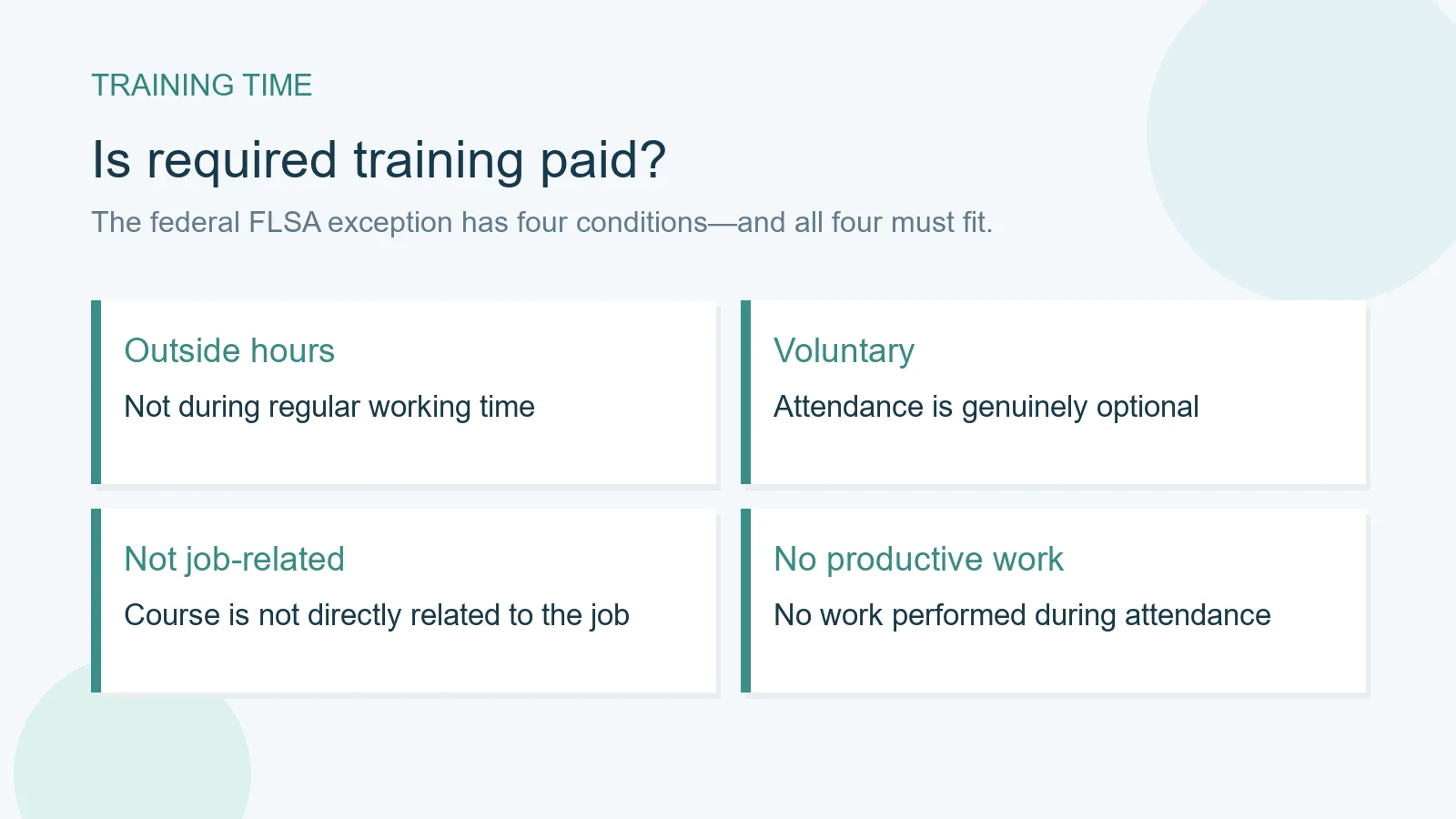
Is mandatory training paid? Under U.S. federal law, required job training usually counts as hours worked for a covered, nonexempt employee. Federal regulations provide a narrow exclusion for some training time only when four conditions are all satisfied: it is outside normal hours, voluntary, unrelated to the employee’s job, and no productive work is performed. If any one condition fails, the exclusion generally does not apply.
State law or a collective bargaining agreement may be more protective. This guide summarizes the federal baseline and gives you a practical way to check your timecard; it is not legal advice.
When is mandatory training paid?
Under the U.S. Department of Labor’s FLSA guidance, training, meetings, and lectures generally count as work time unless all four exclusion tests are satisfied. If attendance is required, the voluntary condition is usually not met. If the training teaches skills used in the current job or includes productive tasks, those facts also weigh against excluding the time.
The rule concerns work time for covered nonexempt employees. It does not mean every course an employee chooses to take must be paid. A course may fall outside paid hours only when the regulatory criteria are met and no separate state rule, contract, or employer policy requires payment.
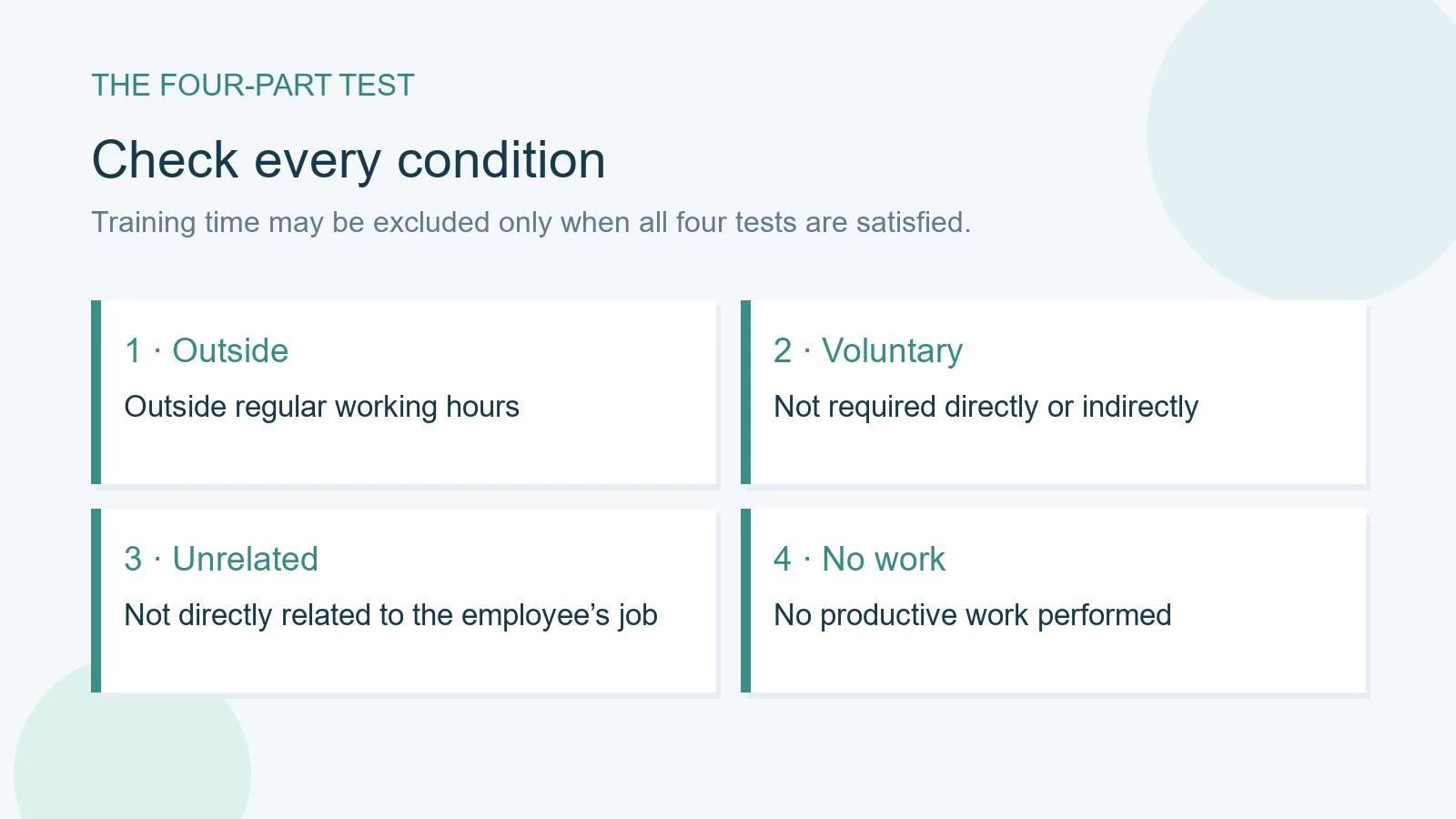
The four federal tests for unpaid training time
- Outside regular working hours. The course takes place outside the employee’s established working hours.
- Voluntary. Attendance is genuinely optional; a supervisor does not require it directly or indirectly.
- Not directly related to the job. The course is not designed to help the employee perform the current job better.
- No productive work. The employee performs no job duties while attending.
All four must be satisfied for the federal exclusion described in 29 C.F.R. § 785.27. A course may be called “optional,” but pressure, consequences for not attending, or an expectation that everyone complete it can make the voluntariness question more complicated. Look at what actually happened, not only the label on the invitation.
Examples: training, meetings, and online courses
| Example | What the federal test suggests | What to record |
|---|---|---|
| Required safety orientation before a shift | Required attendance fails the voluntary test; job-related orientation also fails the unrelated test. | Start/end time, date, and whether the course was required. |
| Required online compliance module at home | Required completion generally does not meet the voluntary test, even if completed remotely. | Actual time spent and course completion evidence. |
| Optional course unrelated to the job, outside work hours | It may qualify for exclusion only if all four conditions apply and no productive work is done. | Course description, optional status, and hours spent. |
| Meeting during a shift | Time spent in a work-related meeting is generally work time, whether or not it is called training. | Meeting start/end and any work completed. |
| Training while helping customers | Productive work during the session means the no-work condition is not met. | Training time and the duties performed during it. |
These are federal starting points. For example, health-care licensing requirements or state-specific training laws may impose extra rules. Check the applicable state labor agency if the employee works outside the federal baseline.
How training can change overtime
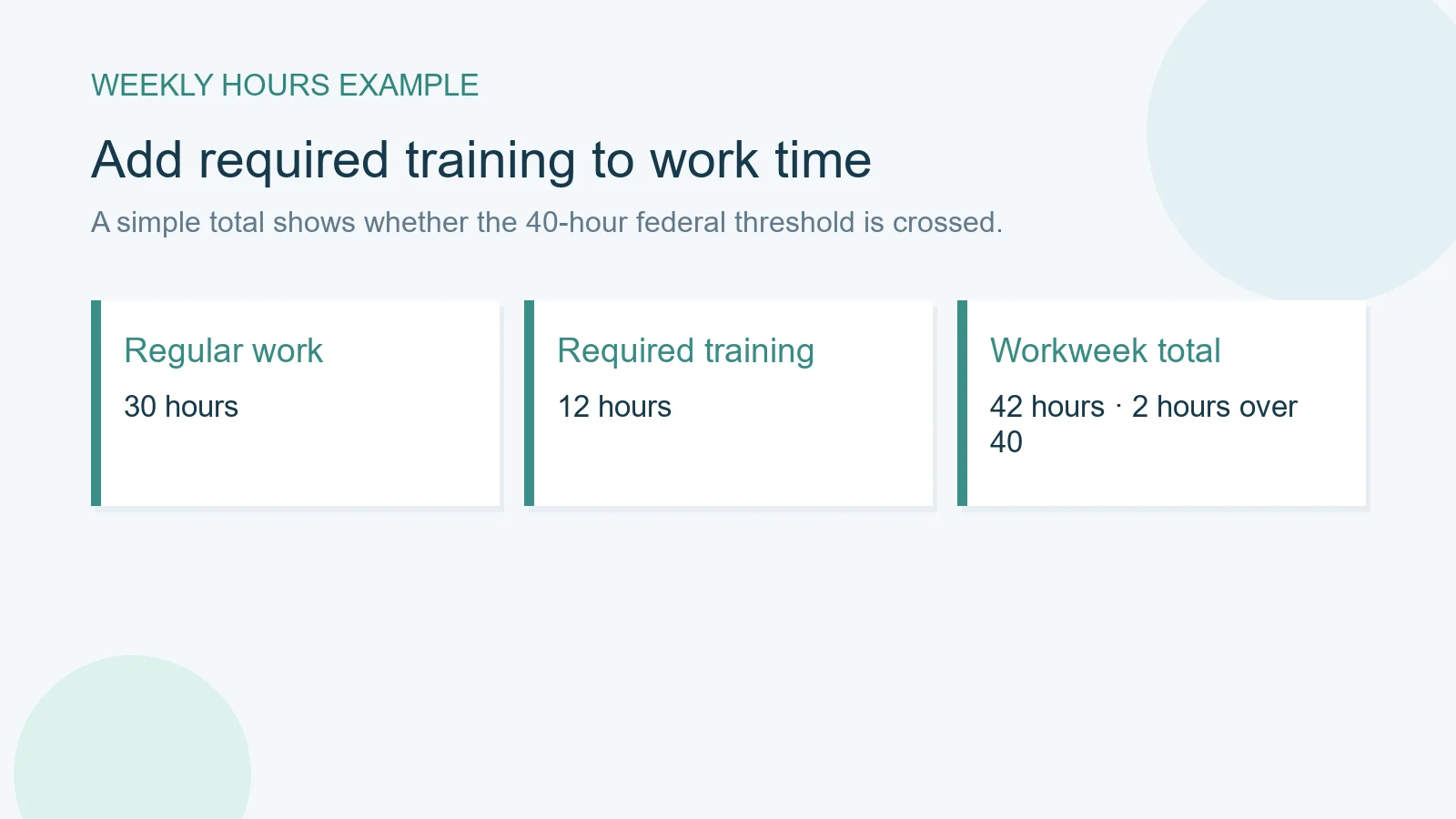
Count compensable training in the fixed workweek when it occurred. For most covered nonexempt employees, federal overtime is due after 40 hours worked in a workweek at not less than one and one-half times the regular rate. The test is not averaged over a two-week paycheck.
Example: an employee works 30 hours and completes 12 hours of required training in the same workweek. If all 42 hours are compensable, the employee has 2 hours over the federal threshold. The correct overtime amount depends on the employee’s regular rate and any state overtime rules. Use the overtime calculator for a basic estimate, and see our regular-rate guide for bonuses and differentials.
How to check your timecard
- Write down the course or meeting date and actual start and stop times.
- Save the invitation, completion record, attendance instruction, and any time entry.
- Compare the training hours with the timecard and the employer’s workweek boundaries.
- Ask payroll how to report a missing course or meeting if it is absent.
Do not automatically count the whole calendar span of an online course as work. Record the time actually spent working on it, and ask how the employer measures completion when the course is self-paced. For rounding and time entries, see when an employer can round clock-in time. A work-hours calculator can help total sessions by workweek.
What to do if training hours are missing
Submit a timecard correction with the date, actual time, and training name. Keep the request and any response. If the employer refuses to count hours that appear compensable or the problem repeats, ask HR or payroll for the written policy and consider contacting the U.S. Department of Labor or your state labor agency.
Managers should make sure required courses and meetings have a clear time-reporting method. A “do not work overtime without approval” rule can be enforced, but it does not by itself eliminate the obligation to pay for work the employer allowed.
Frequently asked questions
Is mandatory training paid for hourly employees?
For covered nonexempt employees, required training generally counts as hours worked. The federal unpaid-training exclusion applies only when all four regulatory conditions are met.
Does online training have to be paid?
Remote delivery does not decide whether time is paid. If the course is required or related to the employee’s job, it will generally fail one or more parts of the federal exclusion.
Are mandatory staff meetings paid?
Work-related meetings generally count as work time for covered nonexempt employees. Record attendance time and any duties performed even if the meeting falls outside the posted shift.
Can required training create overtime?
Yes. Compensable training is generally included with other hours worked in that workweek. Federal overtime usually applies after 40 hours for covered nonexempt employees, subject to state rules and the regular-rate calculation.
What if training was optional but my manager expected me to attend?
That can affect whether attendance was truly voluntary. Save the invitation and any messages about consequences or expectations, and ask payroll or the relevant labor agency how the facts are treated.
Last updated: November 16, 2026. Federal sources were reviewed on that date. Check state and local law for additional training-time requirements.