
Split shift pay explained in practical terms: a split shift divides a workday into separate work periods with a substantial gap between them. The federal FLSA generally does not require an extra “split shift premium” just because a schedule has a long break. California has a specific rule that may require an additional hour of pay at the applicable minimum wage, subject to details and exceptions.
The gap’s length alone does not settle the question. Who set the schedule, whether the employee was free from duty, the length of a bona fide meal period, and state or local law can all matter. This article gives a federal baseline and a California example; it is not legal advice.
Split shift pay explained
What are split shift hours?
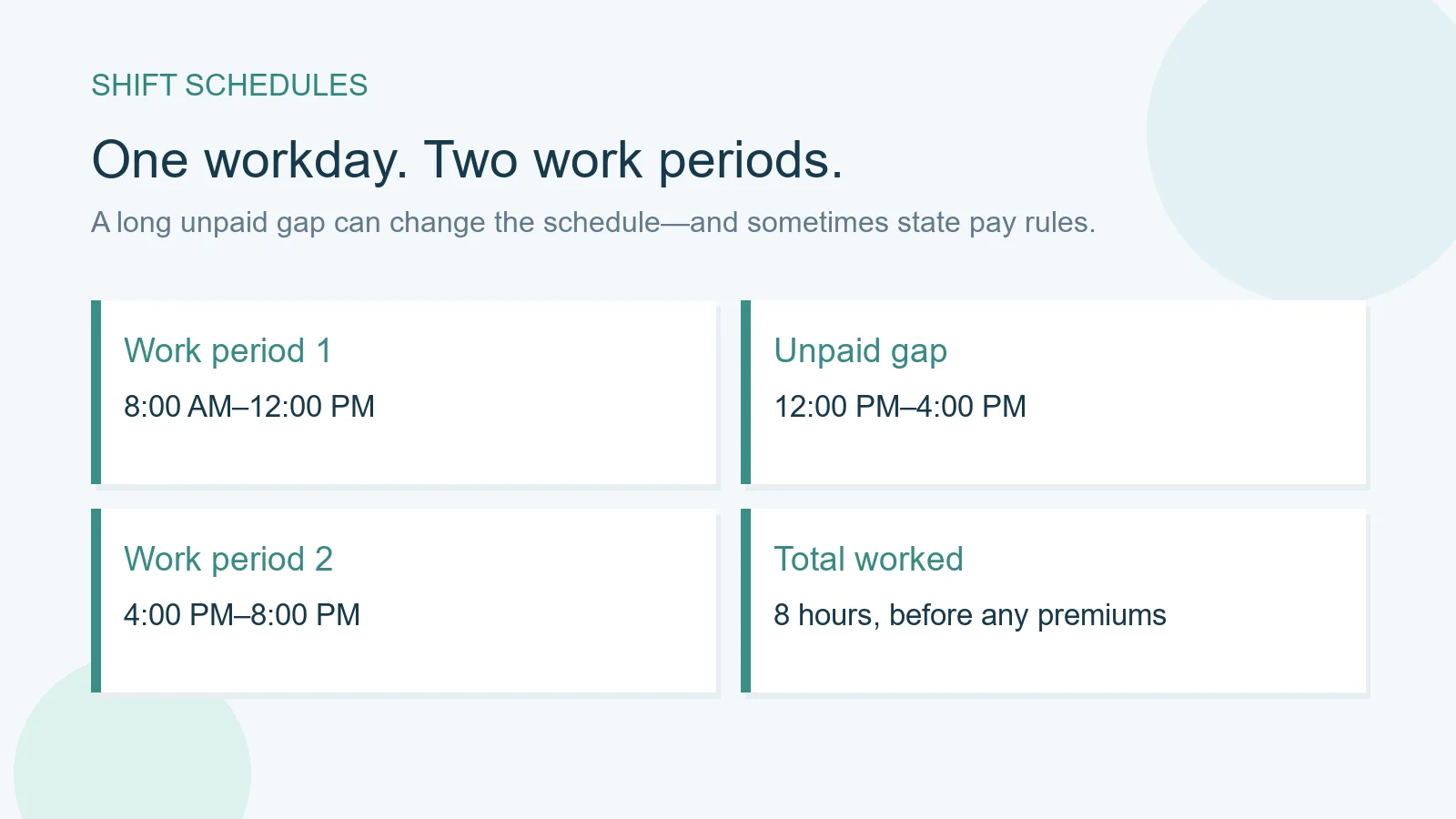
Split shift hours are work periods separated by a lengthy period when the employee is not working. For example, a worker may work 8 a.m. to noon, have a four-hour gap, then work 4 p.m. to 8 p.m. The paid working time is eight hours, but the employee’s day spans twelve hours from first start to final end.
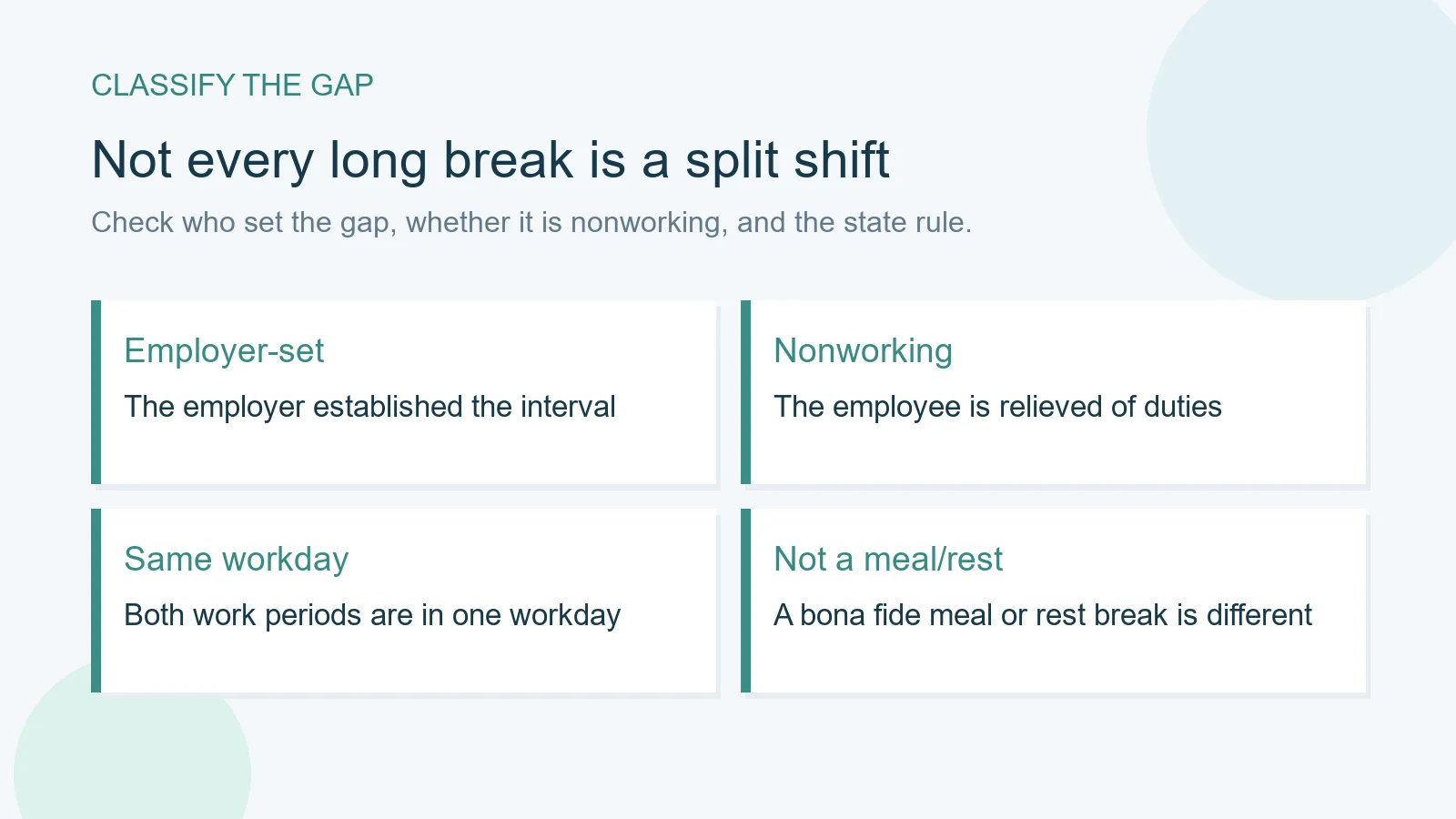
A normal meal break inside one continuous shift is not automatically a split shift. Nor does a schedule become a split shift simply because an employee has a personal errand between work periods. The applicable law may look at whether the employer established the interval, whether it is longer than a bona fide meal period, and whether the employee was actually relieved from duties.
Federal baseline: hours worked and overtime
The federal FLSA does not generally require a separate premium just because a shift is divided by an unpaid gap. But the employer must still pay for compensable work, including duties performed during the gap. If the employee must remain on duty or cannot use the time effectively for personal purposes, the gap may not be unpaid under federal hours-worked rules.
Federal overtime is usually based on hours worked over 40 in a fixed workweek for covered nonexempt employees. A long daily span by itself does not create federal overtime, although state law can set daily overtime or other rules. Do not confuse the unpaid gap with an additional work period when tallying hours. For more on the weekly threshold, read our guide to overtime after 8 hours or 40 hours.
California split shift premium
California’s DLSE describes a split shift as a work schedule interrupted by a non-paid, nonworking period that is longer than a bona fide meal period, within the same workday, and established for the employer’s benefit. A gap created for the employee’s own convenience may be treated differently. California’s rule generally requires one additional hour of pay at no less than the applicable state or local minimum wage, whichever is higher, subject to the wage order and exceptions.
The premium is not automatically one extra hour at the employee’s regular hourly rate. Above-minimum wages earned during the split workday may offset the premium under the California rule. Separate itemization on the wage statement may also be required. Resident employees who live at the workplace and certain other situations have specific exceptions; check the current DLSE guidance and wage order for the exact facts.
How to estimate the possible California premium
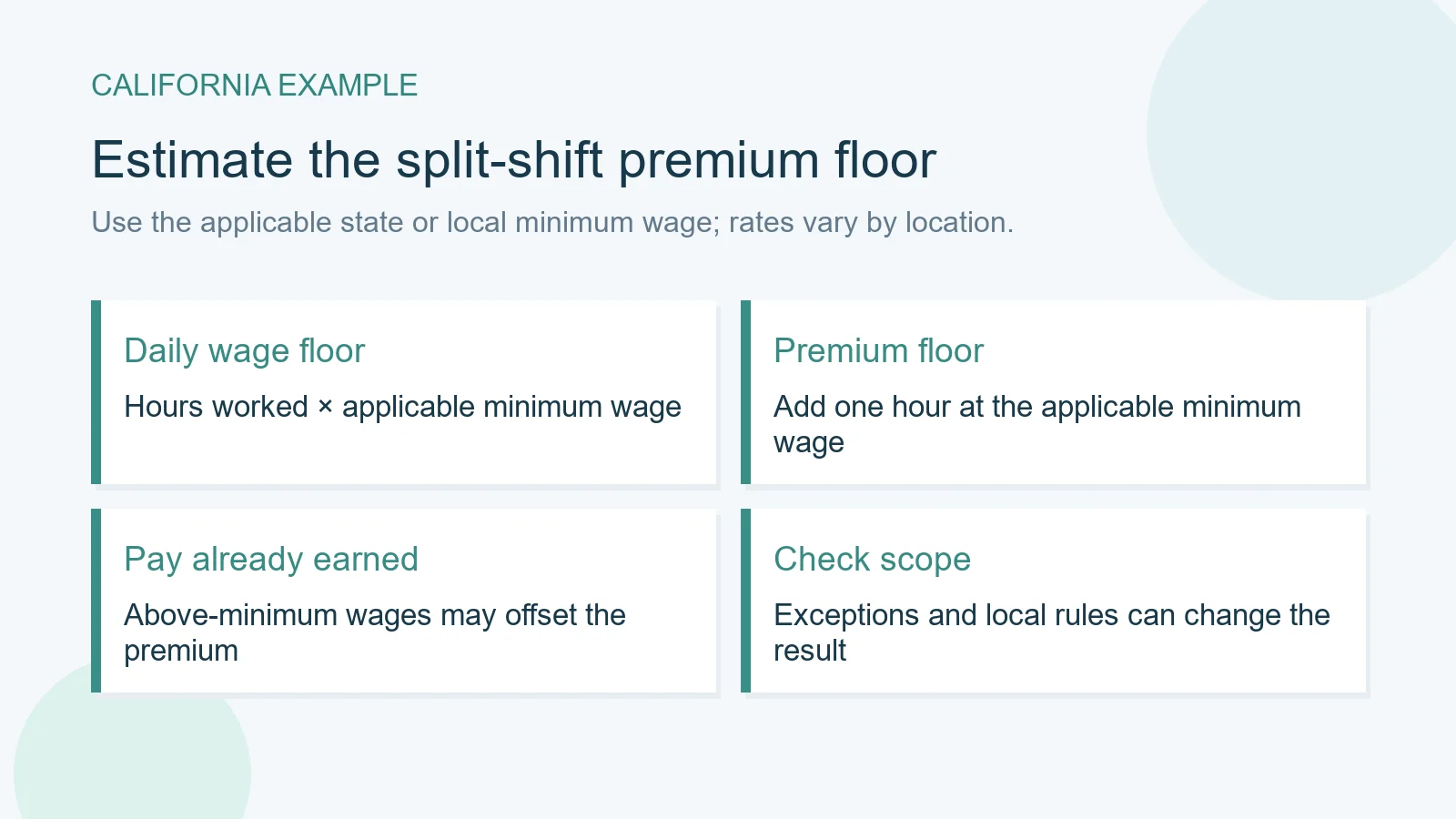
Use the applicable minimum wage for the location and the DLSE’s method; do not reuse an old dollar amount. A simplified way to understand the floor is:
Daily minimum-wage floor = hours worked that day × applicable minimum wage.
Then compare the employee’s wages for that workday with the applicable floor and the additional hour of minimum-wage pay described by California’s split-shift rule. Wages above the minimum may offset the premium. This is only a conceptual guide; the exact calculation depends on current wage rates, wage orders, exemptions, and the employer’s records. The local minimum may exceed the state rate, and rates can change during the year.
For example, do not plug a remembered statewide rate into a current payroll calculation. First identify the city or county where the work was performed, check the applicable current minimum wage, then review the wage order and pay statement. If needed, ask payroll to show how the split shift was classified and how any premium was calculated.
How to check a split-shift paystub
- Write down each work period’s start and end time and the unpaid gap.
- Note whether the schedule was employer-set and whether you were free of duties during the gap.
- Identify the work location and the current state and local minimum wage.
- Check the paystub for all hours worked and any separately listed split-shift premium.
- Ask payroll for the calculation if the premium or hours are missing.
A work-hours calculator can total the paid periods separately. Keep messages showing who created the schedule and any work performed during the gap. If you also worked more than 40 hours in the week, federal or state overtime may apply independently. California daily overtime rules may also affect the calculation; use the California overtime calculator as an estimate, not as a legal determination.
What if you were called back during the gap?
Record the actual work, even if it was brief. A required phone call, customer service task, or equipment check can affect whether that time is compensable and whether the gap was truly nonworking. Report the additional time through the normal timecard correction process and keep the response.
If a pay issue remains, start with payroll or HR when appropriate. For California questions, the DLSE publishes guidance and accepts wage claims. For federal minimum wage or overtime questions, contact the U.S. Department of Labor’s Wage and Hour Division. Keep pay statements, schedules, and dated time notes.
Frequently asked questions
Does federal law require split shift pay?
The FLSA generally does not require a special premium solely because a workday is split. It still requires payment for compensable work and federal overtime when the weekly conditions are met.
How long does a break have to be to count as a split shift?
There is no single nationwide gap length that creates a premium. California guidance considers whether the nonworking interval is longer than a bona fide meal period and other facts; other jurisdictions may use different rules.
How much is California’s split-shift premium?
California generally requires one additional hour at the applicable minimum wage, subject to the detailed rule, possible offsets, and exceptions. Use the current state or local minimum wage for the work location rather than an old fixed dollar amount.
Does a split shift count as overtime?
The gap itself is not usually counted as hours worked if the employee is genuinely relieved of duty. Count the actual work periods, then apply federal weekly and any state daily overtime rules.
What if I work during the unpaid gap?
Record each task and the time spent, then report it as work through the employer’s process. Work during the gap may affect both pay for those minutes and whether the interval was truly nonworking.
Last updated: November 16, 2026. California sources were checked on that date. Minimum-wage rates and local requirements can change; verify the current rate and applicable wage order before calculating pay.