
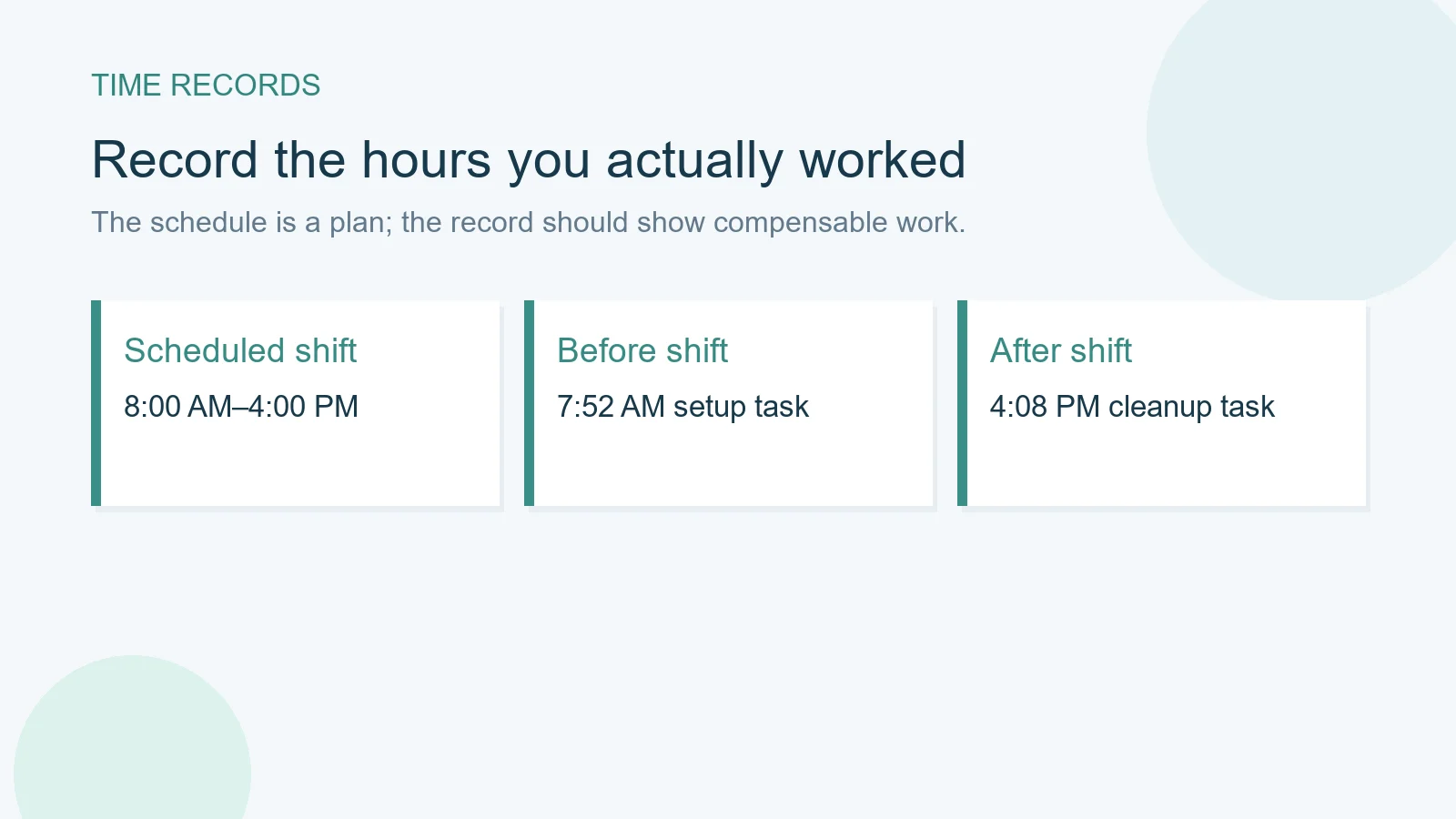
If you are asking whether off-the-clock work is illegal, the key question is whether a covered, nonexempt employee performed work that the employer required, knew about, or allowed. The Fair Labor Standards Act (FLSA) generally requires employers to count and pay for compensable work time, including work outside a posted shift. A schedule or timecard entry does not erase work that actually happened.
This guide explains common examples, how to correct a time record, and what to document. State and local laws, contracts, and exemptions can change the result. This is general information, not legal advice.
Is off the clock work illegal?
What counts as off-the-clock work?
Off-the-clock work is job-related work that an employer fails to record or pay for. Under federal guidance, work can be compensable even when it was not requested, if the employer knew or had reason to believe it was being performed and allowed it to continue. Employers are responsible for accurate records of hours worked by covered nonexempt employees.
“Not scheduled” and “not authorized” do not automatically mean “not work.” An employer may enforce a rule that employees must get approval before working extra time. But if a supervisor accepts or permits the work, the employer generally still has to count the time; the policy can be enforced separately.
Common examples: when should the minutes be recorded?
| Situation | What to check | Practical next step |
|---|---|---|
| Required setup before clock-in | Was the task part of the job and required or known to the employer? | Record the actual start of the task and ask payroll to correct the timecard. |
| Cleanup or closing after clock-out | Did the employee finish assigned work, secure equipment, or complete a required handoff? | Write down the finish time and task; submit it through the normal correction process. |
| Checking email after hours | Was a response expected, performed, or monitored by a supervisor? | Log the date, approximate duration, and work performed; ask how to report it. |
| Work through an unpaid meal | Was the employee fully relieved from duties for the meal? | Report interruptions or work performed during the break. See our guide to a lunch deduction when you work through it. |
| Travel between work locations | Was this ordinary commuting or travel during the workday? | Separate commute time from travel between job sites; see when travel time counts as work. |
These examples are prompts for a fact check, not automatic legal conclusions. For example, a voluntary commute to the workplace is usually treated differently from a required task performed after arrival. The details of control, benefit, and employer knowledge matter.
How to calculate the missing time
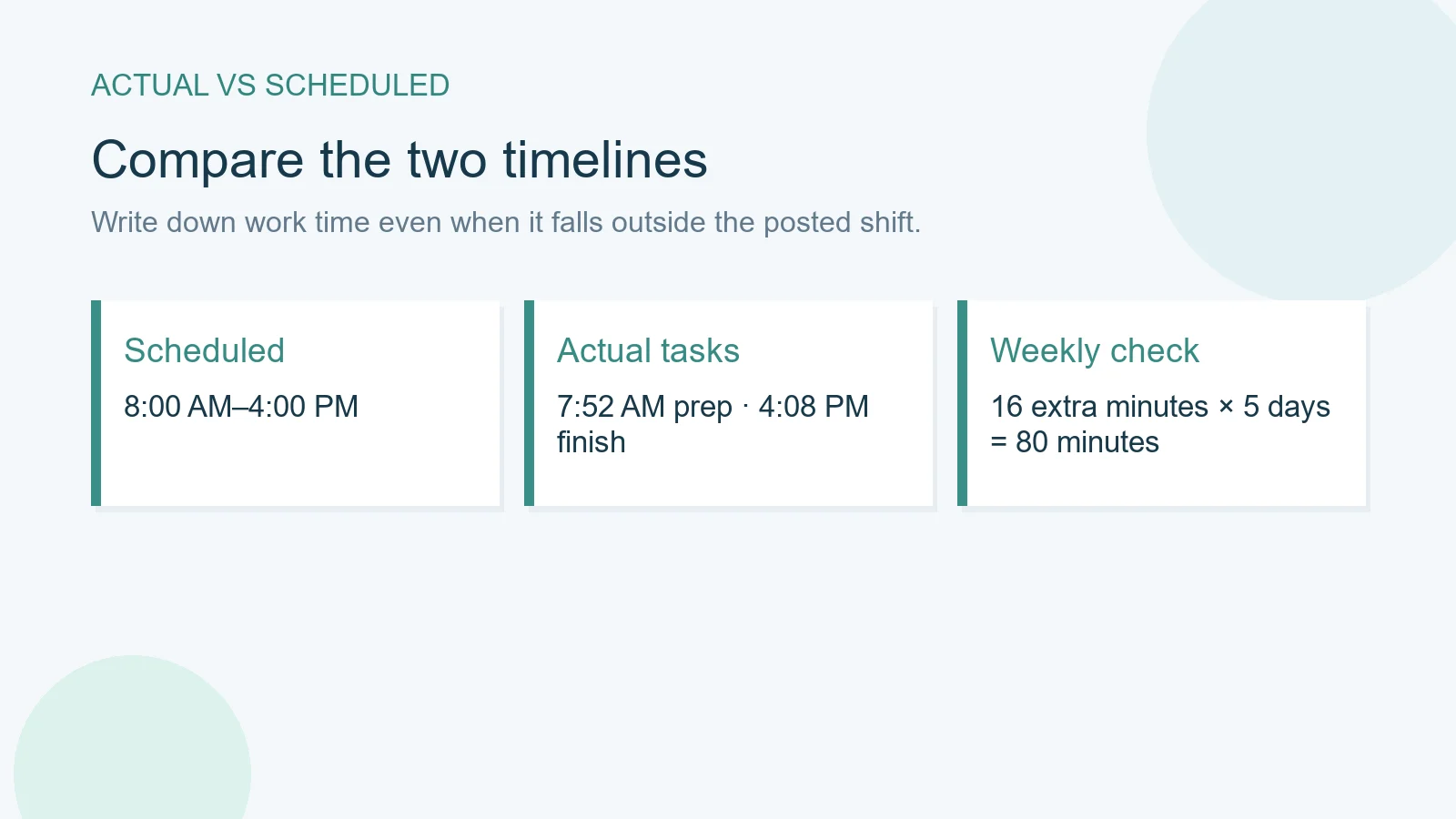
Write the actual start and end times for each task. If a task took 8 minutes before work and 6 minutes after work for five days, that is 70 minutes in the week: (8 + 6) × 5 = 70. Keep the calculation separate from the legal question of whether each task is compensable.
Use a work hours calculator to total recorded periods, or compare the result with your timecard calculation. Federal overtime generally applies after 40 hours in a fixed workweek for covered nonexempt employees; a biweekly paycheck does not combine two workweeks into one test.
How to fix a timecard without losing the record
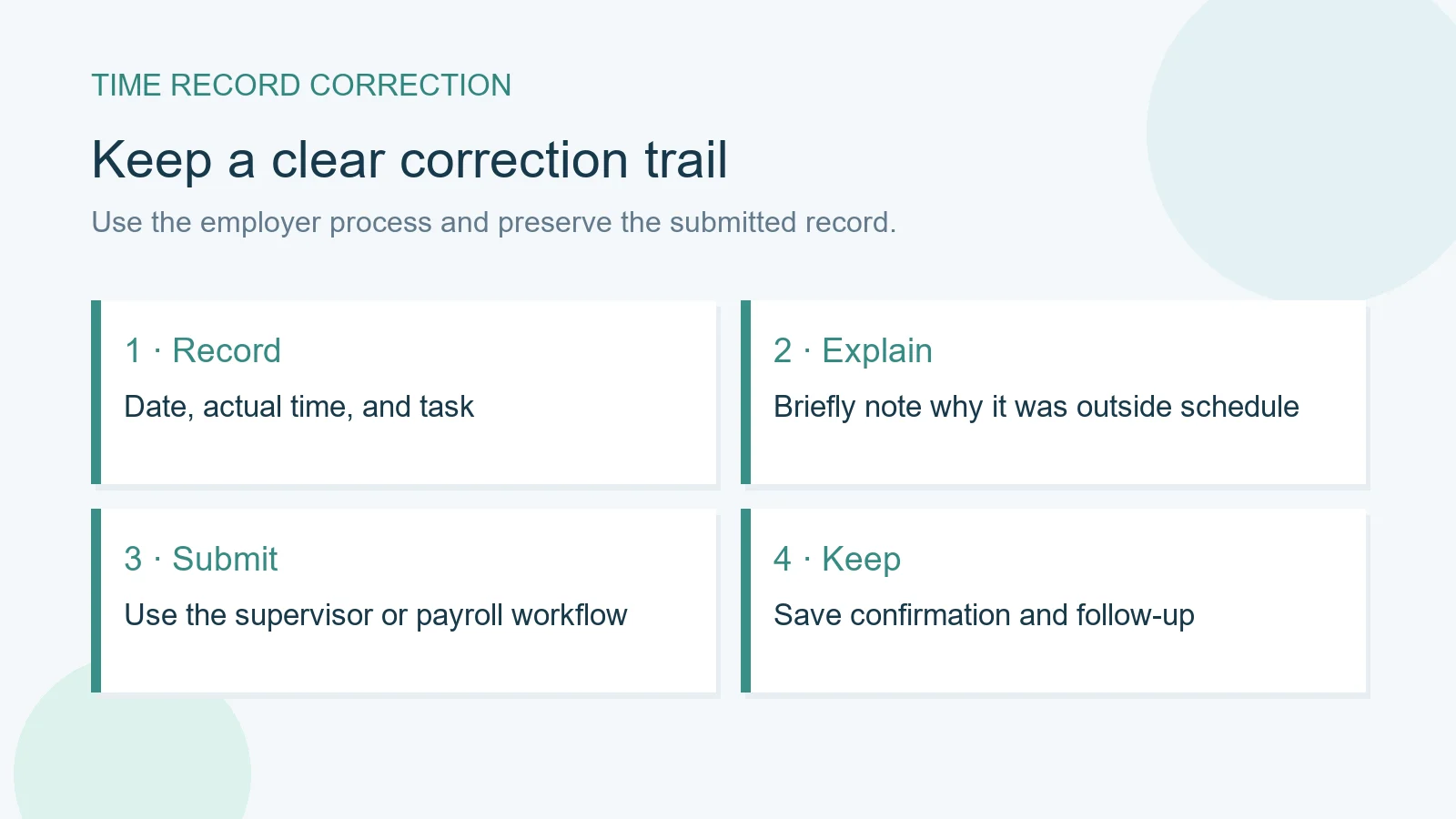
- List the date, actual time, and specific task.
- Submit a correction using the employer’s payroll or supervisor process.
- State whether the time is an estimate and explain how you calculated it.
- Keep the request, response, and any revised pay statement.
Do not change a record to match the schedule if it is inaccurate. If a supervisor asks you to omit time, save the instruction and raise the issue with payroll, HR, a union representative, or another appropriate contact. Our timecard guide explains how to make a clear correction.
What records should you keep?
Keep your own dated notes of start and stop times, tasks, messages assigning work, submitted corrections, and pay statements. Do not take confidential customer or company data that you are not allowed to keep. The federal recordkeeping rules place record-maintenance duties on employers; personal notes can help you explain a discrepancy but do not replace the employer’s records.
When to escalate a pay problem
Start with the payroll correction process when it is safe and practical. If pay remains short, the same unpaid tasks continue, or you face pressure to alter a record, consider contacting the U.S. Department of Labor’s Wage and Hour Division or your state labor agency. Keep dates and copies of relevant records. Filing deadlines and retaliation protections depend on the law and facts, so do not wait if a deadline may apply.
For a broader overview of federal overtime thresholds and state differences, read overtime after 8 hours or 40 hours. The FLSA’s 40-hour test is based on each fixed workweek, not on a two-week pay period.
Frequently asked questions
Is it illegal for an employer to ask employees to work off the clock?
For covered nonexempt employees, failing to pay for compensable work can violate the FLSA. A rule against unauthorized overtime does not usually let an employer accept permitted work without paying for it.
Do I have to be paid for work before my scheduled shift?
Required or employer-known job tasks may count as work even when they happen before the scheduled start. Record the actual time and ask payroll how to submit a correction.
Does checking email after hours count as work?
It can, depending on whether work was performed, expected, or allowed and how much time it took. Note the dates, tasks, and time spent rather than assuming every notification is compensable.
What if my timecard already says I clocked out?
Use the correction process to report the actual work time and keep a copy of what you submitted. Do not silently overwrite the record or guess at a time you cannot support.
Does the 40-hour overtime rule apply to every worker?
No. Coverage and exemption status matter, and state law can add protections. The U.S. Department of Labor or a state labor agency can explain which rules may apply to a specific situation.
Last updated: November 16, 2026. This evergreen guide summarizes federal sources reviewed on that date; check state and local rules for your location.